

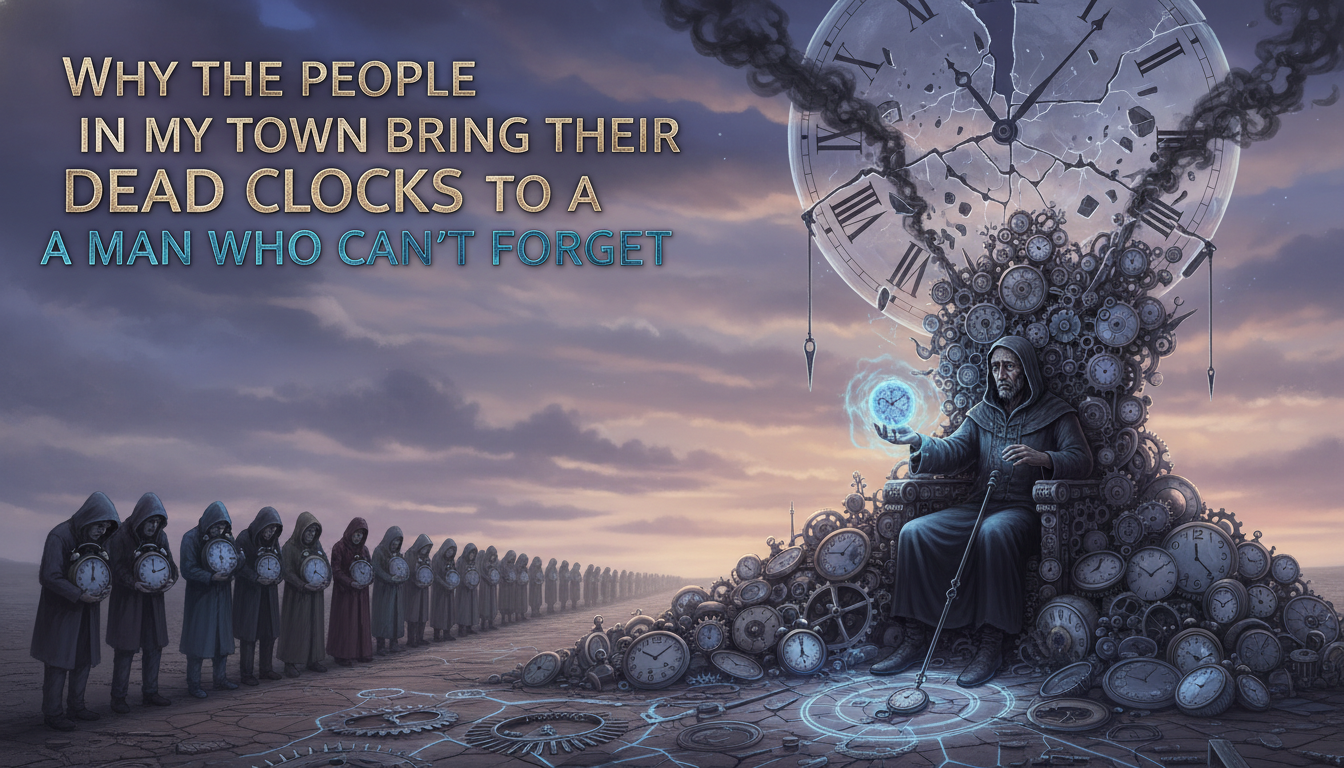
Ray sat at his workbench. The air in the room was thick with the smell of old oil and cold coffee. A single lamp cast a yellow circle on the table. Outside that circle, the shadows were deep and heavy. Ray liked the shadows. They didn’t ask questions. They didn’t look at him with the pity he saw in the eyes of the people at the grocery store.
In the center of the light lay a small gold watch. The glass was cracked. The hands were bent into a shape that looked like a scream. This watch was the reason Ray’s house was silent. Three years ago, he had been looking at this very watch. He had been so busy trying to see a tiny speck of dust that he didn’t see his son, Leo, run into the street. He didn’t see the truck. He only heard the sound. It was a wet, heavy thud. It was a sound that now lived inside Ray’s chest, beating like a second heart.
Ray’s hands shook as he picked up a pair of tweezers. He was a man who lived in the cracks of time. He was a man who wanted to disappear. But the people in the town of Oakhaven wouldn’t let him. They knew he was the only one who could fix the things that were truly broken.
There was a soft knock at the door. Ray didn’t move. He didn’t want to see anyone. But the knocking didn’t stop. It was steady. It was patient.
Ray stood up. His knees popped. He felt a sharp ache in his lower back. He walked to the door and opened it. A young girl named Sutton stood there. She was maybe ten years old. She held a wooden music box wrapped in a tattered blue ribbon.
“My dad said you fix things,” Sutton said. Her voice was small, but it had a jagged edge to it. “He said you fix the things that shouldn’t be fixed.”
Ray looked at the box. It wasn’t just old. It looked tired. The wood was grey and peeling. “I fix clocks, kid. Not toys.”
“It’s not a toy,” Sutton said. She stepped forward, forcing Ray to move back. She put the box on his workbench, right next to his son’s broken watch. “It’s my mom. She left last year. This is the only thing she left behind. It stopped playing the night she walked out. My dad tried to fix it with a hammer. Now it just makes a clicking sound. It sounds like someone sobbing.”
Ray looked at the girl. Her eyes were wide and dry. She wasn’t crying, but her skin looked pale, almost translucent. He could see the pulse jumping in her neck. He felt a coldness in his own stomach. He knew that look. It was the look of someone who was waiting for a ghost to come home.
“I’ll look at it,” Ray muttered.
“Thank you,” she said. She didn’t smile. She just turned and walked back into the dark.
Ray sat back down. He touched the music box. The moment his fingers brushed the wood, a wave of heat slammed into him. It wasn’t the heat of a fire. It was the heat of an argument. He heard muffled shouting in his mind. He heard a door slam so hard the pictures on the walls rattled.
He opened the lid. The gears inside were jammed with something black and sticky. It wasn’t oil. It felt like dried tears. As he poked at the mechanism, his own heart began to race. He felt a sudden, sharp pain in his chest, right where his lungs met his ribs. He felt the loneliness of that little girl. It was a heavy, crushing weight. It was the feeling of standing at a window and watching tail lights disappear into the fog.
He worked through the night. He didn’t use normal tools. He used a needle to pick away the black gunk. He used a soft brush to sweep away the echoes of the shouting. Every time he cleared a gear, his own breathing became easier. By dawn, the music box was clean. He wound the key.
The music didn’t just play. It breathed. It was a soft, humming tune that smelled like lavender and warm milk. The “unfixable” was fixed.
The next day, a man named Benny came by. Benny was a big man with hands like literal hams. He brought a rusted lantern.
“It won’t light,” Benny said. He wouldn’t look Ray in the eye. “Every time I strike a match, the flame just turns black and dies. I need it, Ray. I can’t sleep in the dark. Not since the fire at the mill.”
Ray took the lantern. When he touched the cold metal, he felt his skin crawl. He felt the smell of smoke in the back of his throat. He felt the terror of being trapped in a room with no exit. He saw Benny’s secret fear: that he was the one who had left the stove on. That he was the one who had caused the fire that took his friends.
Ray cleaned the soot from the glass. But the soot wasn’t just carbon. It was guilt. It stained Ray’s fingers. It turned his sink black. He scrubbed and scrubbed until his knuckles bled. He replaced the wick with a string he had soaked in salt water: the salt of a man’s regret.
When Benny came back, Ray handed him the lantern.
“Try it,” Ray said.
Benny struck a match. The flame didn’t die. It grew. It was a bright, golden light that filled the room. Benny looked at the light, and his shoulders finally dropped. He looked like he had been holding his breath for ten years and finally let it out. He didn’t say thank you. He just gripped the handle and walked out, his path lit by a fire that no longer burned.
This went on for weeks. Ray became a magnet for the broken.
Cassidy brought a compass that only pointed to the cemetery. Ray found a tiny piece of a wedding ring jammed in the needle. Once he removed it, the needle swung back to North, and Cassidy finally stopped walking toward the graves.
Vince brought a pocket watch that ran backward. Ray found that the spring was wound with the hair of a woman who had passed away twenty years ago. He untangled the hair, placed it in a small envelope for Vince, and the watch began to move forward again.
With every item Ray fixed, the town grew a little lighter. People started talking to each other on the street. They didn’t look at the ground as much. They looked at each other. They shared their stories of how the “Clock Man” had fixed their ghosts.
But Ray was still in the dark.
His son’s gold watch sat on the corner of the bench. It was the only thing he hadn’t touched. He was afraid. He was terrified that if he fixed it, the memory of Leo would fade. He was afraid that if the watch started ticking, it would mean that time was moving on, and he wasn’t ready to leave his son behind in the silence of three years ago.
One night, a storm rolled in. The wind howled through the cracks in the walls. The house groaned like a dying animal. Ray sat at his bench, staring at the gold watch. His eyes were stinging. His throat felt like he had swallowed a handful of dry sand.
He picked up the watch. The gold felt freezing against his skin. It felt like his son’s forehead on that day in the morgue.
“I’m sorry,” Ray whispered. His voice broke. The sound was thin and pathetic in the big, empty house. “I’m so sorry I wasn’t looking.”
He began to work. He didn’t use his eyes. He used his heart. He felt for the gears that were bent by the impact. He felt for the spring that had snapped from the sudden stop.
As he worked, the memories came. They weren’t the bad memories. They weren’t the sound of the truck or the sight of the blood. He saw Leo’s messy hair. He heard the way Leo laughed when he saw a dog wearing a sweater. He felt the small, sticky weight of Leo’s hand in his.
Ray’s tears fell onto the watch. They ran into the tiny gears. They washed away the dust of the street. They lubricated the dry, rusted wheels.
He found the mainspring. It was twisted into a knot. He slowly, carefully, began to straighten it. Every millimeter he moved the metal, he felt a tug in his own chest. It felt like he was pulling a needle out of his soul. It hurt. It hurt so much he had to lean his head against the table and gasp for air. His body felt like it was being folded in half.
He didn’t stop. He pushed through the pain. He polished the cracked glass until the edges were smooth. He straightened the hands.
Then, he wound it.
The sound was small. *Tick. Tick. Tick.*
It wasn’t a scream. It wasn’t a thud. It was a heartbeat.
Ray sat there in the yellow light, holding the watch against his ear. He closed his eyes. For the first time in three years, the silence in the house didn’t feel like a vacuum. It felt like a rest.
The next morning, there was another knock on the door. It wasn’t a customer. It was Sutton and Benny and Cassidy. They were standing on his porch, holding a basket of bread and a thermos of hot tea.
“We thought you might be hungry,” Sutton said. She was wearing a bright yellow coat. The music box was tucked under her arm, and it was humming a happy tune.
Ray looked at them. He looked at the street where his life had ended. He looked at the watch in his hand. It was still ticking.
He stepped out onto the porch. The sun was hitting the tops of the trees. It was a new day. It was a scary, bright, loud day.
“I am,” Ray said. His voice was scratchy, but it was strong. “I’m very hungry.”
He didn’t fix the world. He didn’t bring back the dead. But as he sat on the porch with his neighbors, the watch in his pocket kept time. It didn’t tell him how much he had lost. It told him how much he still had left to give. He realized that being broken wasn’t the end. It was just a way for the light to get inside the gears.