
Hank checked the seal on his rubber mask. The air in the lower stacks tasted like copper and old sweat. In this city, you didn’t pay for bread with gold. You paid with the time you spent at your grandmother’s house or the way your first dog smelled after a rainstorm. The rich people bought those memories to feel something real. Hank’s job was to sort the leftovers. He was an archivist: a fancy word for a man who moved heavy jars of soul-stuff from one shelf to another.
He had a Deep Wound where his own life used to be. Hank had sold almost everything. He couldn’t remember his mother’s face or the name of the street where he grew up. He had traded them for a warm coat and a room that didn’t leak. Now, he was just a suit of skin that knew how to move boxes. He was safe because he was empty. Being empty meant nothing could hurt you. Or so he thought.
The lower vault was a structural nightmare. The ceiling sagged like a wet cardboard box. Hank moved his flashlight over the crates. Most jars were clear or a soft, glowing blue. Those were the happy memories: weddings, birthdays, the taste of a cold peach. But in the back corner, behind a pile of rusted scrap, he found a crate wrapped in heavy chains. It didn’t glow. It swallowed the light.
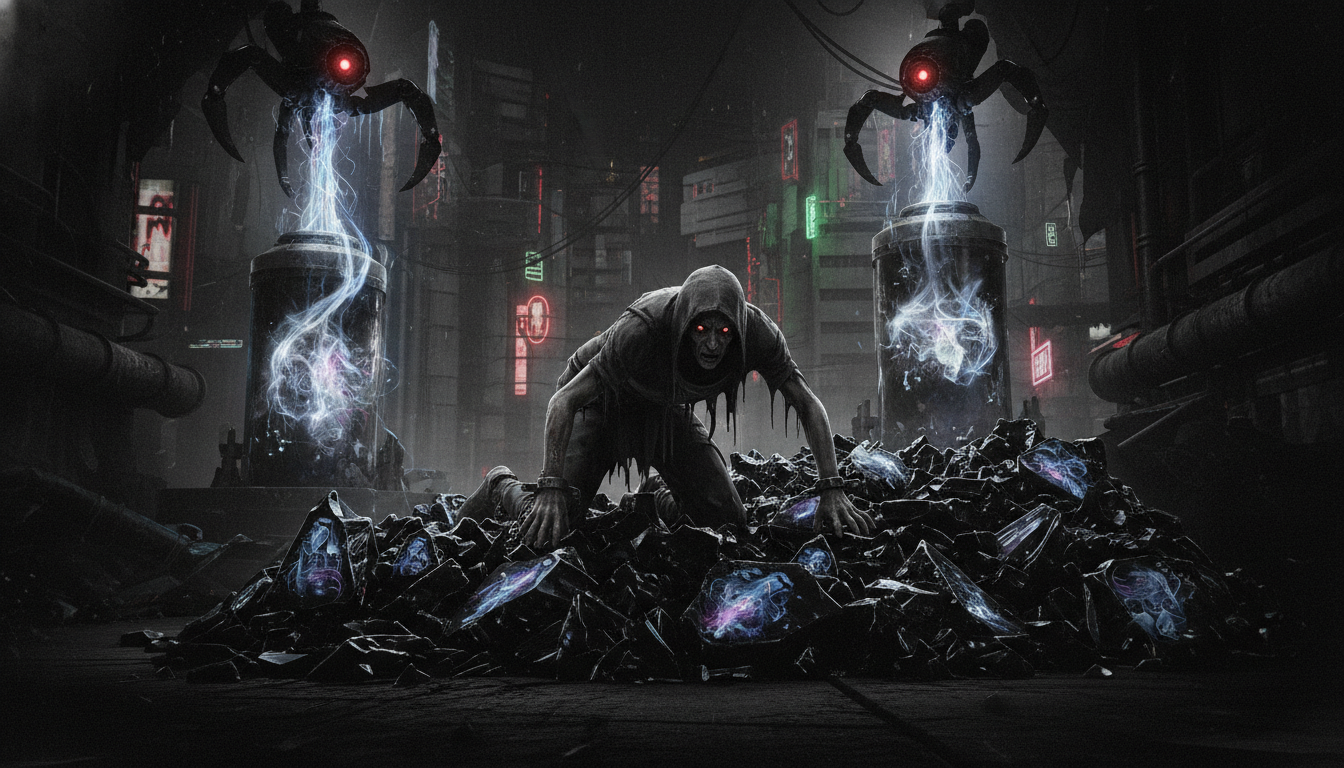
Hank used a crowbar to snap the lock. Inside were twelve jars made of thick, black glass. They felt cold through his gloves. They didn’t feel like memories. They felt like a threat. A smart man would have called the overseer. A survivalist would have walked away and locked the door. But Hank felt a pull in his hollow chest. He wanted to know what was heavy enough to be chained up in the dark.
He unscrewed the lid of the first jar just a tiny bit.
The sound didn’t come through his ears. It came through his teeth. It was a high, thin screech that tasted like salt. A cloud of oily smoke spilled out. It didn’t float. It crawled. It went straight for Hank’s hand: searching for a way in.
Hank slammed the lid shut, but it was too late. A single drop of the black liquid had touched his wrist.
The fear hit him like a physical blow to the stomach. It wasn’t his fear. It was the fear of a thousand people at the exact moment they realized they were going to die. He saw a dark hallway. He felt the hot breath of something behind him. He felt the sharp, stinging snap of a bone breaking. It was a trauma cache. The city didn’t just harvest the good stuff. They took the nightmares, too. They took the moments people were too broken to keep and they hid them here.
Hank staggered back. His heart hammered against his ribs like a bird in a cage. His vision blurred. He saw Troy, the lead guard, standing at the end of the aisle. But Troy wasn’t Troy anymore. In the grip of the black memory, Troy looked like a monster with long, jagged fingers and eyes like empty holes.
Hank’s survival instinct screamed at him. Secure the perimeter. Eliminate the threat. But he couldn’t move. The memory was a parasite. It was filling the holes where his mother’s face used to be. He wasn’t Hank anymore. He was a boy in a burning house. He was a woman being pushed into the sea. He was every scream that had ever been silenced.
The other black jars started to rattle. The vibration shook the metal shelves. The glass began to spiderweb.
“Help,” Hank tried to say, but his voice broke. It sounded like a dry branch snapping.
The first jar exploded. The black smoke poured out in a thick wave. It didn’t have a shape, but it had a weight. It felt like being buried alive in cold sand. Hank fell to his knees. The floor was freezing. He looked at his hands. They were disappearing into the dark.
He realized then why these were illegal. They weren’t just memories. They were a virus. If you give people a way to get rid of their pain, they will do it. They will sell every bad thing that ever happened to them until they are nothing but a smile and a blank stare. But that pain has to go somewhere. It doesn’t just vanish. It waits. It rots. It grows teeth.
The vault door hissed shut. The security system had sensed the leak. Hank was locked in with the things the city wanted to forget.
He crawled toward the door, his fingers scraping against the concrete. The air was getting thicker. It felt like breathing ink. He could hear the voices now. They weren’t speaking words. They were just sobbing. A deep, soulful ache started in his chest and spread to his limbs. He remembered a girl named Sia. He remembered her screaming as the harvest needles went in. He remembered Tatum, who had sold the memory of his own name just to buy a loaf of bread for a sister who was already dead.
Hank’s mask cracked. The seal was gone.
The terror was absolute. It was the feeling of a shadow standing right behind you in a room where you are supposed to be alone. It was the realization that the thing under the bed is real, and it is hungry.
Hank pressed his face against the cold metal of the door. He wanted to cry, but he didn’t have any memories of how to do it. He was a survivalist. He knew how to find water. He knew how to build a fire. He knew how to hide from a storm. But there was no hiding from this. You can’t outrun the things that live inside your own head.
The jars continued to shatter: one by one. The sound was like a chorus of falling mirrors.
Hank felt a hand on his shoulder. It was cold. It was heavy. He turned around, but there was no one there. There was only the black smoke, swirling into the shape of a person who was missing a heart.
He closed his eyes. He tried to think of something happy to fight the dark. He tried to remember the taste of the peach or the warmth of the sun. But those belonged to the rich people now. He had sold his light a long time ago. He had nothing left but the dark.
The smoke entered his mouth. It tasted like dirt and old tears.
Hank didn’t scream. He just leaned his head against the door and waited for the blanking to take him. He was finally getting what he wanted. He wouldn’t have to be empty anymore. He would be full of everyone else’s pain until there was no room left for Hank at all.
The last thing he felt was the stinging of his eyes as they finally, mercifully, began to leak. He was crying, and he didn’t even know why. He just knew it was the only real thing he had left.
Outside the door, the city hummed. People walked the streets with bright, manufactured smiles. They felt light. They felt happy. They felt nothing at all. And deep underground, in the dark, the black glass kept breaking.