

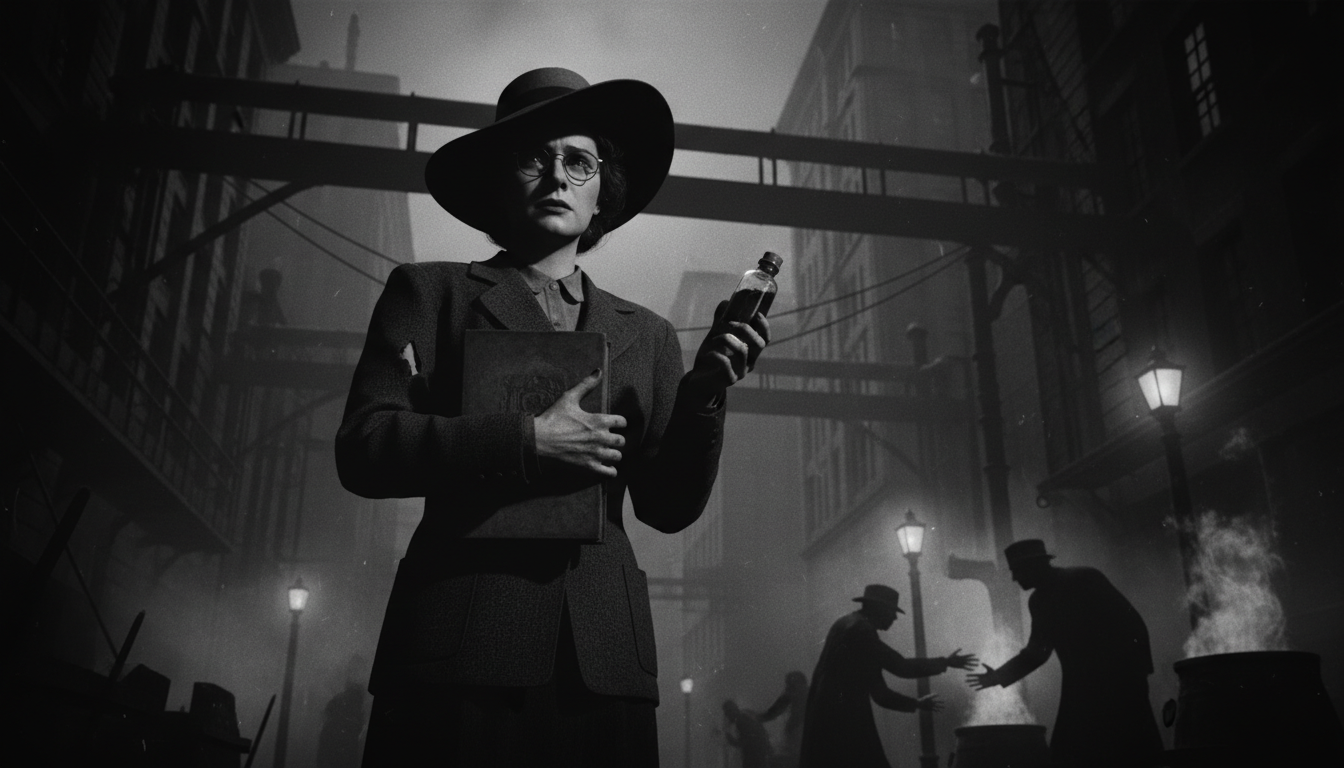
Trudy’s hands were always black. It wasn’t the kind of dirt you could scrub off with a bit of soap and a rough brush. This was the ink of the High Court: thick, greasy, and smelling of old copper. She worked in the basement of the Great Archive, a place where the steam pipes hissed like angry snakes and the sun never reached. The worst part of the job wasn’t the cold or the damp. It was the hole in her head where her mother’s face used to be. Trudy had sold that memory ten years ago to pay for a winter coat and a week of soup. Now, when she tried to think of her mother, she only saw a grey blur.
The ink she filed away every day was made of things like that. In this city, if you ran out of coins, you went to the Extraction Room. You gave them the smell of your grandmother’s kitchen or the feeling of your first kiss. The doctors would pull it out of your head with cold needles, and the chemists would cook it down into Liquid Black. That was the only ink the lawyers used. They said a contract wasn’t real unless it was written with the “weight of a soul.” If you signed a debt in Liquid Black, you felt that debt in your bones until the day you died.
One Tuesday, Trudy was moving a crate of heavy jars when one of them tipped over. It didn’t shatter. These jars were thick, meant to hold the heaviest secrets of the empire. But the lid popped off, and a single drop of ink splashed onto Trudy’s thumb.
She didn’t wipe it away. She couldn’t. As the ink touched her skin, her head filled with the sound of a bicycle bell. She saw a street she didn’t recognize, lined with trees that turned bright gold in the autumn. She felt the wind on her face and the taste of a sour apple. It wasn’t her memory, but for a second, she felt like she was someone else. She felt loved. She felt whole. Then the ink dried, and the feeling vanished. The street and the bicycle and the gold leaves were gone, leaving her in the dark basement with nothing but the smell of soot.
Trudy looked at the jar. The label was written in a cramped, clinical hand: *Debt 402, Property of the Coal Guild.*
She thought about the people in the Grey District. They were the ones who had sold too much. They sat on the street corners with empty eyes, unable to remember their own names or the way home. The city called them “The Clean,” but Trudy knew they were just hollow.
That night, Trudy didn’t go straight home. She took a small glass bottle from the trash and filled it with the ink from the tilted jar. She hid it in her boot. Her heart hammered against her ribs, a frantic, ticking clock. If the guards caught her, they wouldn’t just fire her. They would take everything. They would drain her until she was just a breathing shell.
She walked to the Grey District. The air there was thick with the smell of wet trash and hopelessness. She found an old man named Maury sitting on a broken crate. Maury used to be a baker, but now he just stared at his own hands as if he’d never seen them before.
“Maury,” Trudy whispered, kneeling in the dirt. “Look at me.”
Maury didn’t look up. He didn’t even blink. Trudy pulled the glass bottle from her boot. She took a small brush from her pocket, dipped it in the ink, and drew a tiny circle on Maury’s wrist.
The effect was like a lightning strike. Maury’s back straightened. His eyes cleared, turning from a dull milk color to a sharp, bright blue. He gasped, a long, shaky sound that seemed to come from his toes.
“The flour,” Maury whispered. His voice was cracked like dry earth. “The way it looked like snow on the table. My wife… her name was Sarah. She wore a blue ribbon in her hair every Sunday.”
He started to cry. They weren’t sad tears: they were the kind of tears a man sheds when he finds a lost child. He gripped Trudy’s hand, his fingers trembling. For a moment, the soot-choked street didn’t matter. The debt didn’t matter. He was Maury the baker again.
“Thank you,” he breathed. “I remembered the smell of the yeast.”
Trudy went back the next day. And the day after that. She became a shadow in the archives, a ghost who moved between the shelves with a quiet purpose. She learned which jars held the best parts of people. She looked for “Sundays,” “First Dances,” and “The Sight of the Ocean.” She smuggled them out in medicine bottles, in hollowed-out loaves of bread, and under her tongue.
She started meeting people in the back alleys. There was Jax, who forgot he was a father. There was Trudy’s neighbor, Quinn, who had sold the memory of his own wedding to pay for his sister’s medicine. One by one, Trudy gave them back their pieces. She painted their skin with the ink of their own lives.
But something else began to happen.
In the High Court, the lawyers started to panic. The contracts were failing. In the big ledger books, the signatures were turning from black to a dull, faded grey. The ink was literally lifting off the page, pulled away by a force no one understood. When a person remembered who they were, the debt they owed the city simply vanished. The “weight” was gone because the memory had returned to its rightful owner.
One afternoon, the head archivist called Trudy into his office. He was a small, pinched man with skin like parchment. He pointed to a stack of papers on his desk.
“Look at this,” he barked. “The Land Deed for the North Docks. It’s blank. Every word has evaporated. It’s happening all over the city. People are waking up, Trudy. They’re walking away from their jobs. They’re claiming houses they haven’t lived in for years.”
Trudy kept her face still. Her heart felt like it was expanding like a panicked pufferfish, but she didn’t let a muscle twitch. “Maybe the ink was bad, sir,” she said softly.
The archivist leaned in close. He smelled like peppermint and old sweat. “The ink is never bad. Someone is stealing the soul of this city. And when I find them, I’ll make sure they forget their own mother’s name.”
Trudy felt a coldness in her chest. She thought about the hole in her own head. She thought about the blue blur that should have been her mother’s face.
That night, she didn’t go to the Grey District. She went to the Restricted Vault. It was behind a heavy iron door that required three different keys, but Trudy had been watching the guards for years. She knew the rhythm of their boots on the stone floor. She knew when the steam pipes would hiss loud enough to hide the sound of a lock turning.
She found the jar she had been looking for. It was small, tucked away in the back of a shelf labeled *Internal Staff: Collateral.*
She opened it. The ink inside was a deep, shimmering violet. She dipped her finger into the jar and touched it to her temple.
The world tilted. Suddenly, she wasn’t in a dark basement. She was standing in a small garden. The sun was warm on her shoulders. A woman was standing over a patch of herbs, laughing. She had curly hair the color of toasted bread and eyes like green glass.
“Trudy,” the woman said, reaching out a hand. “Look at the rosemary. It’s finally blooming.”
Trudy started to sob. The memory hit her with the force of a physical blow, a sweet, painful ache that filled her lungs until she couldn’t breathe. Her mother. It was her mother. She remembered the scratchy feel of her mother’s wool sweater and the way she sang off-key while she washed the dishes.
She stood there for a long time, the tears washing the soot from her cheeks.
When she finally left the vault, she didn’t hide. She walked right past the guards, her head held high. She carried a large bucket of the Liquid Black. She walked to the center of the Great Archive, where the massive steam engine hummed, powering the entire city’s legal machine.
She didn’t pour the ink onto the floor. She poured it into the water tank of the engine.
The effect was almost instant. The steam didn’t come out white anymore. It came out in a thick, dark cloud that smelled of rain, old books, and forgotten summers. The wind caught the cloud and carried it over the rooftops, over the factories, and down into the narrowest streets of the Grey District.
People stopped in their tracks. They looked up as the dark mist settled over them like a blanket. Men and women who hadn’t smiled in years suddenly leaned against walls, clutching their chests as a thousand memories rushed back into their hearts at once. Mothers remembered their children. Soldiers remembered why they were fighting. The poor remembered that they once owned their own names.
In the High Court, every contract turned to dust. The deeds, the debts, and the laws of the empire simply crumbled into grey ash.
Trudy stood on the roof of the archive, watching the city wake up. Her hands were still stained black, but she didn’t care. She closed her eyes and thought of the green glass eyes of her mother. She thought of the rosemary in the sun.
She didn’t know what would happen tomorrow. The empire was gone, and the city was a mess of people who finally knew what they had lost. But as she stood in the fading light, Trudy realized that for the first time in ten years, she knew exactly who she was. And that was a weight she was more than happy to carry.