

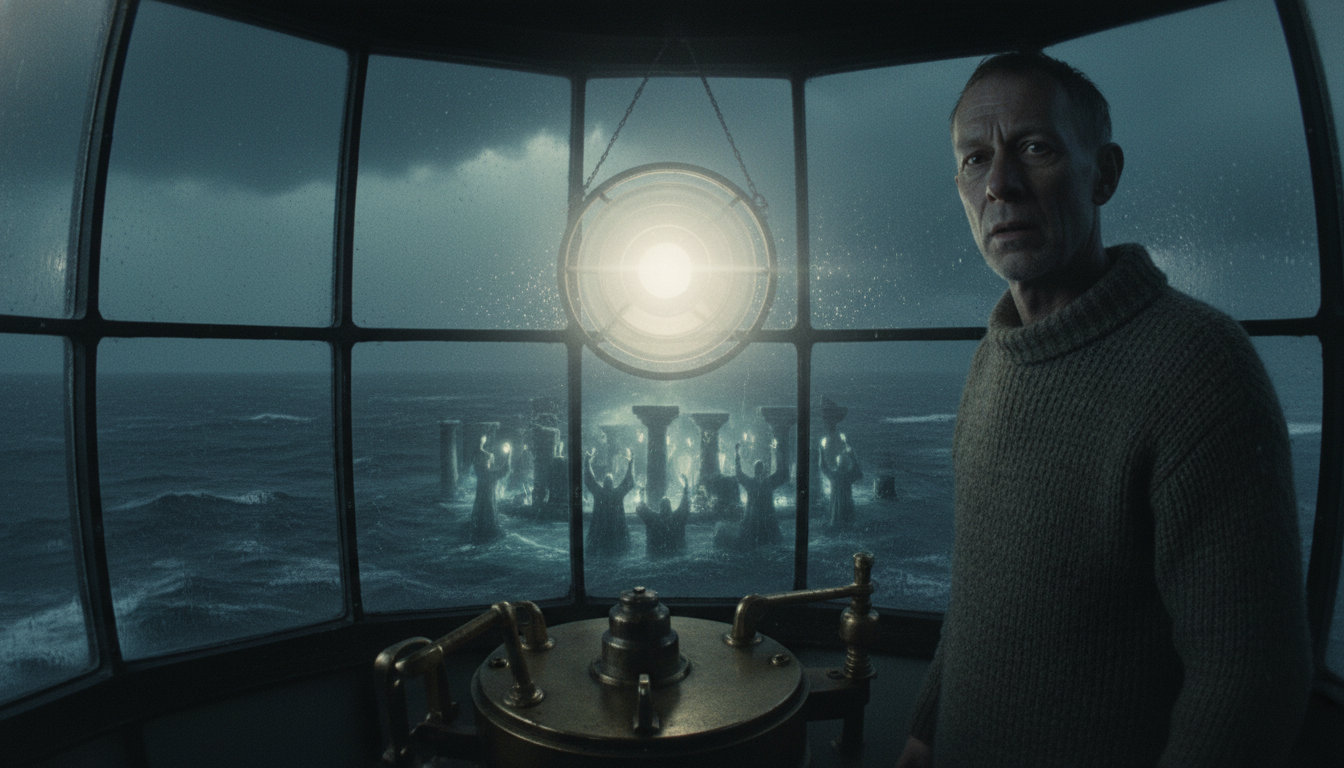
I spent thirty years looking at things people weren’t supposed to see. I’ve seen crime scenes that looked like a butcher shop exploded, and I’ve seen the quiet kind of death that stays in your lungs like cold soot. But the case of Silas and the Black Rock Light is the only one that makes me want to go back in time. I don’t want to go back to fix it. I want to go back to the days before I knew what was hiding under the water. I miss the way the world felt before I read those logs. It was a simpler time. You could trust the ground to stay still and the sea to stay deep.
Silas moved to that rock in 1922. He was a tall man with hands that looked like they were carved out of old oak. He took the job because his wife, Lana, had died the winter before. He told the hiring board he wanted the quiet. He needed a place where the only thing he had to care for was a lens and a wick. He was a good man, the kind who polished his boots every morning even if no one was there to see them. He just wanted to remember Lana in peace. He missed the smell of her lavender soap and the way she hummed while she brushed her hair. That was his vital need: to keep her ghost alive in his head.
I found his journal in a wooden crate under a pile of rusted chains. The first few months were normal. He wrote about the weather. He wrote about the gulls. He wrote about how much he missed the taste of fresh bread. But by the fourth month, the handwriting started to change. It got shaky. It looked like the wind was blowing the pen across the page.
He started talking about the rhythm.
The Black Rock Light had a specific pulse. It was a slow, steady blink. Two seconds on, four seconds off. Silas spent his nights in the glass room at the top of the tower. He watched that beam of light cut through the dark. It was his job to keep the clockwork gears turning. He liked the mechanical click of the machine. It reminded him of a heart. But in his notes, he said the light started to change. He said it wasn’t clicking anymore. It was thumping.
He wrote that he felt a coldness in his chest every time the light flashed. It wasn’t just a feeling. He actually measured his own pulse. He sat there with his fingers on his wrist, counting. His heart was beating sixty times a minute. Then, the light would flash. He wrote that his heart would skip a beat to catch up with the lamp. He called it the Great Sync. He thought it was a trick of the mind. He thought he was just lonely.
But then he heard the response.
It came from the floor of the ocean. He described it as a low, heavy sound. It was like a giant drum being hit under a mile of water. Thump. Thump. Thump. It didn’t sound like a whale or a shifting rock. It sounded like a million hearts all hitting the same note at the same time. He wrote that when the light flashed, the ocean floor answered.
Silas started to lose his grip on the world he knew. He stopped polishing his boots. He stopped eating the tinned beef. He spent all his time staring into the black waves. He was looking for something. He thought Lana was down there. He had this crazy idea that the light was a bridge. He believed that if he could just keep the light burning bright enough, the things in the water would bring her back.
I remember the way the air felt when I finally stepped onto that rock to investigate. It was years after he disappeared, but the salt still felt like it was biting my skin. The lighthouse was empty. There was no body. There was no blood. There was just a pile of clothes neatly folded by the railing at the very top.
I looked at the gears of the light. They were jammed with something thick and black. It looked like old oil, but it smelled like rotting seaweed and iron. When I touched it, my fingers went numb instantly. It was a cold that didn’t just stay on the skin. It went deep into the bone.
In the last entry of his log, Silas wrote about the “Submerged.” He said they weren’t people anymore. They were a single, massive thing that lived in the dark. They needed the light to guide their breathing. They were ancient, and they were hungry for his thoughts. He said they offered him a deal. They would give him back the feeling of Lana’s hand in his, but he had to give the light his “spark.”
The detective in me wants to say he just went crazy. Isolation does that to a man. It turns the brain into a house with too many mirrors. You start seeing things that aren’t there. But I can’t explain the evidence. I found a drawing he made on the wall of the lantern room. It wasn’t a picture of a monster. It was a map of the stars, but the stars were all in the wrong places. They were underwater.
I also found his watch. It was sitting on the ledge. The glass was cracked. The hands weren’t moving at all, but I could still hear it. I put my ear to it, expecting a tick. Instead, I heard that same low thump. It was the sound of a heart beating in a bucket of water.
The worst part is the nostalgia. I think about my own life now. I’m retired. I sit on my porch and watch the cars go by. Sometimes, I catch myself tapping my foot to a rhythm I can’t quite hear. I miss the days when I thought the dark was just empty space. I miss being a young cop who thought every mystery had a human answer.
Silas wanted to feel his wife’s warmth one more time. He was a man who loved too much. That was his secret fear: that the love would fade away like smoke. He chose the light because he thought it would save him. He didn’t realize the light was a dinner bell.
When the sun goes down now, I don’t like to look at the horizon. I don’t like the way the stars reflect on the water. It looks like eyes. It looks like a city under the waves, waiting for the next beat of the drum. I keep my house bright. I turn on every lamp. I try to drown out the sound of my own heart, just in case something down there is listening.
Humans like to think we are the masters of the earth. We build towers and we light fires. We think we are safe because we have names for everything. But Silas learned the truth. There are things in the deep that don’t have names. They have rhythms. And once your heart starts beating in time with theirs, you don’t belong to the world of the living anymore. You belong to the tide.
I still have his boots. I kept them as evidence, but I never turned them in. Sometimes I look at them and think about the man who kept them so clean. I wonder if he’s still down there, held in the cold arms of the ocean, listening to the thumping. I hope he found Lana. But mostly, I hope he can’t hear the light anymore. Because once you hear it, you can never go back to the silence.