

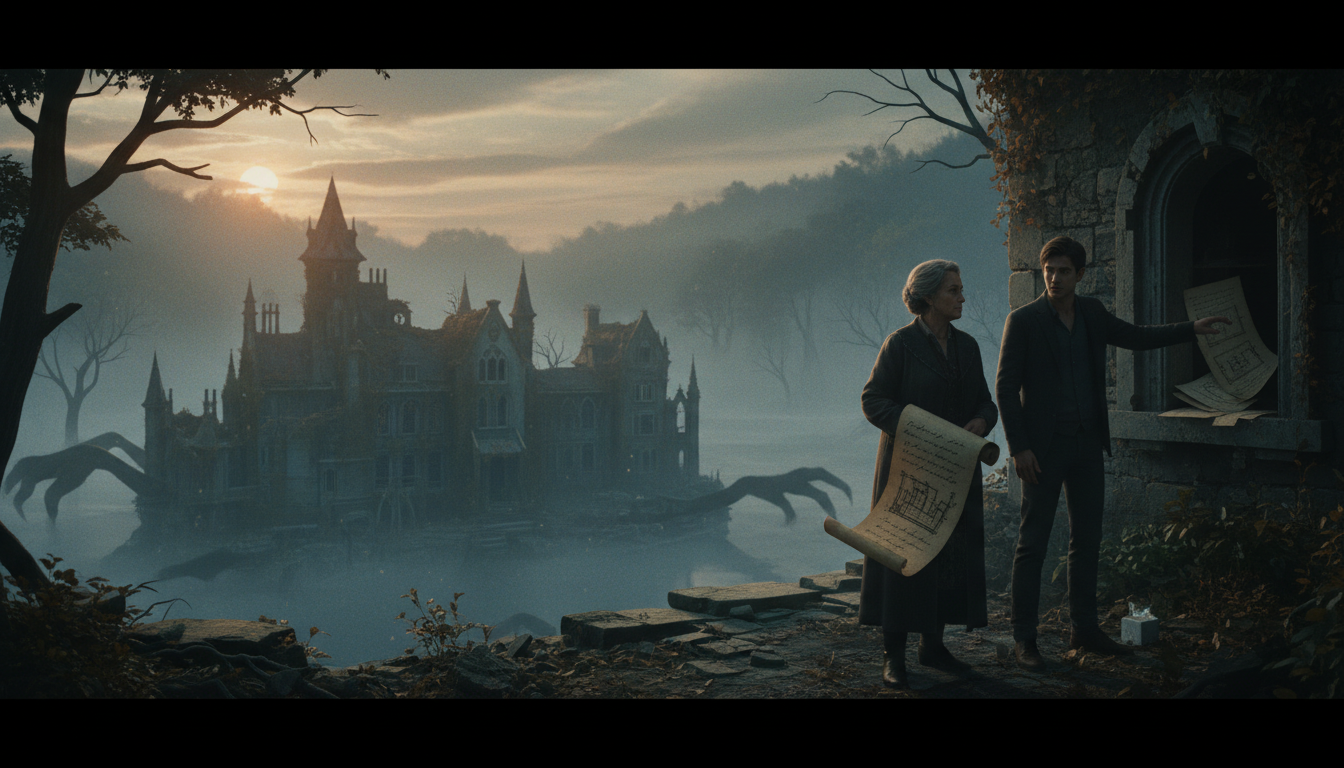
The house sat on the hill like a giant, dying animal. It was called Blackwood. People in town said it was cursed, but Silas knew better. Houses aren’t cursed. Only the people inside them are. He stood in the foyer and felt the cold air crawl up his legs. He was fifty years old, and he had spent the last ten of those years in a hole of his own making. He was a man who used to build dreams out of steel and glass. Then he made one mistake, a beam snapped, a man died, and Silas became a ghost who fixed old porches for beer money.
Maya arrived an hour later. She drove a car that cost more than Silas had made in five years. She was young, sharp, and had eyes that looked like they were constantly searching for a fight. She was the one who won the bid to redo the estate. Silas was just the man she was forced to hire because he knew the bones of these old mountain houses better than anyone.
“You’re late,” Maya said. She didn’t look at him. She looked at the ceiling. “The roof is sagging. The floors are soft. This place is a mess.”
Silas adjusted his cap. His voice came out like gravel rubbing together. “The house is tired, Maya. It’s been holding itself up for a hundred years with nobody to love it. You’d sag too.”
She finally looked at him. There was a flicker of something in her eyes. It wasn’t pity. It was a weird kind of recognition. He saw the way her hand shook just a little when she opened her leather bag. She was scared. She was the star of her firm, but everyone was waiting for her to trip. She needed this win to stay alive in that world. Silas just needed to pay his rent and keep the silence in his head from getting too loud.
They worked in separate rooms for three weeks. The tension was a physical thing. It was a heavy weight in the air between them. They fought over everything. She wanted modern lines. He wanted to keep the hand-carved oak. She wanted light. He knew the house liked its shadows.
Late one night, the rain started hammering the tin roof. The power flickered and died. Silas found Maya in the library, sitting on a crate with a single candle. She looked small. The sharp edges of her personality had softened in the yellow light.
“My father worked until he died,” she said. Her voice was quiet, almost a whisper. “He never finished anything. He just left a trail of half-done houses and a pile of debt. I told myself I’d be different. I’d be the one who finishes things.”
Silas sat on the floor across from her. His knees popped. “I used to think finishing things was the point, too. But sometimes, you finish a building and you realize you forgot to build a life to go inside it.”
He saw a tear track through the dust on her cheek. He wanted to reach out, to touch her hand, but he felt like a man made of salt. If he touched her, he might just dissolve. He showed her a small kindness instead. He went to his truck and brought back his old wool blanket. He draped it over her shoulders. Her skin felt hot where his knuckles brushed her neck. It was the first time in a decade he felt a spark of something other than regret.
The next morning, they tore into the wall behind the master fireplace. They were looking for a rot in the beams, but they found a tin box instead. Inside were the original blueprints from 1912. They were drawn by hand, beautiful and precise. Tucked inside the paper was a letter.
Silas read it aloud. His raspy voice felt too rough for the words. It was a letter from the first architect to the woman who was supposed to live there. He had built the house for her. He had hidden her name in the floor patterns. He had spent his every cent and every hour making a palace for a woman who never came. The letter was dated the day she married someone else.
“I built a cage for a bird that was already gone,” Silas read. The last line of the letter was a jagged scrawl: “The wood will rot, the stone will crack, but the waiting is what will finally bring the roof down.”
Maya stood very still. The silence in the room felt like a physical blow. They looked at the blueprints, then at each other. The chemistry that had been simmering under their arguments finally boiled over. It wasn’t a movie kiss. It was desperate. It was the sound of two people trying to fill a hole in their chests with another person’s breath. Her mouth tasted like coffee and salt. Silas felt a deep, soul-deep ache. He realized he was falling for a woman who was already planning her exit.
She was the future. He was a ghost.
They finished the house. They worked side by side, their hands often touching as they sanded the old wood. They found a rhythm. For a month, they lived in a bubble of sawdust and shared sandwiches. They slept on the floor in front of the fireplace they fixed together. Silas felt a hope he hadn’t known in years. He thought maybe the house wasn’t the only thing being restored.
On the final day, the house was beautiful. It glowed. The oak was polished until it looked like honey. The windows were clear, letting in the sharp mountain light. It was a masterpiece.
Maya stood by the front door with her suitcases. Her car was idling in the driveway. The sun was hitting her face, making her look like a painting.
“Come with me, Silas,” she said. But her voice didn’t have any weight behind it. She was already thinking about the next project, the next city, the next climb.
Silas looked at his hands. They were scarred and stained with walnut oil. “I can’t leave the mountains, Maya. I finally learned how to stand still. If I run now, I’ll never stop.”
“I can’t stay,” she whispered. “There’s nothing for me here but a pretty building.”
“There’s me,” he said. It was the hardest thing he had ever said. It was a confession. It was an opening of a door he had kept locked for ten years.
Maya looked at him, and for a second, he saw the girl who was scared of being like her father. Then, the mask came back. She reached out and touched his cheek. Her fingers were cold.
“You’re a good man, Silas. But you’re part of the house now. And I don’t live in houses. I just build them.”
She turned and walked to the car. She didn’t look back. Silas stood on the porch and watched the dust from her tires settle on the gravel. He went back inside and sat in the library. He pulled out the old blueprints and the letter from the man who waited.
He realized then that the curse of Blackwood wasn’t ghosts or bad luck. The curse was that the house was too perfect. It was a place where people realized what they were missing, just in time to watch it drive away.
Silas stayed in the house. He became the caretaker. Every night, he sat in the dark and listened to the wood groan. He felt the ache in his chest, a steady, pulsing throb that matched the heartbeat of the old building. He had fixed the rot in the walls, but he couldn’t fix the rot in his own life. He had found his soul, only to realize it was designed to be alone.
He looked at the empty chair across from him. The dust was already starting to settle on it. He closed his eyes and tried to remember the smell of her hair, but all he could smell was the old wood and the cold, mountain air. The house was finished. And Silas was finally, completely, broken.