
Hayes checked the seals on his oxygen pack. The rubber was cracked. It was old gear, the kind of stuff they gave to men who didn’t matter anymore. He used a bit of sticky tape to cover the leak. It wasn’t perfect, but it would hold for an hour. In this hole, an hour was a lifetime.
Hayes used to be the man who drew the world. He had the best ink and the finest paper. Then he made one mistake. He mapped a mountain pass that turned out to be a dead end. A whole team of explorers never came back. They stripped him of his title. They called him a ghost. Now, the world above was falling apart. The magnetic poles were flipping. The air was thinning out. People were suffocating in their sleep. Hayes didn’t want to save the world for glory. He wanted to save it because he couldn’t stand the thought of the last map he ever drew being a lie.
Mick stood by the entrance of the cave. He was a scavenger who didn’t have a tongue. He had lost it to a sickness years ago. Mick didn’t need words. He moved with a quiet grace, checking his climbing harness with quick, sure fingers. He held up a small, faded photograph. It was a picture of a dog sitting in a patch of sunlight. The dog looked happy. The grass looked green. Hayes felt a sharp poke in his chest looking at it. He remembered when the sun didn’t feel like a threat. He remembered the smell of rain on a hot sidewalk. That was what they were fighting for.
“Ready?” Hayes asked.
Mick nodded. He pointed his flashlight into the throat of the earth.
The Labyrinth wasn’t just a bunch of caves. It was a living thing. The walls were made of a strange, dark stone that felt warm to the touch. Every few minutes, the ground would moan. The tunnels would slide to the left or the right. It was a giant puzzle that changed its shape based on the rhythm of the stars far above.
“Stay close,” Hayes said. “If the walls shift while we’re between them, we’re just paint on the rocks.”
They stepped inside. The air tasted like copper and old pennies. Hayes kept his eyes on his watch. He wasn’t looking at the time. He was looking at the beat. *Thump. Thump. Thump.* The labyrinth moved every sixty seconds. They had to run during the stillness and hide during the shift.
They moved like insects through the guts of the planet. Hayes led the way, using a piece of chalk to mark the floor. He knew the chalk marks wouldn’t stay. The floor would eventually slide away and be replaced by a new one. But it gave him a sense of peace. It was what he knew.
After three hours, the air got heavy. Mick stopped and tapped his nose. He smelled something. Hayes leaned in. It wasn’t the smell of dirt. It was the smell of ozone. Like a thunderstorm was trapped in a box.
“We’re close,” Hayes whispered.
The ground gave a massive shudder. A wall of rock slammed down right behind them. Dust filled the air. Hayes coughed, his lungs burning. He checked Mick. Mick was fine, but he was staring at the photo of the dog again. The edges of the photo were damp from his sweat. It was the only thing Mick had left from the world before the sky turned gray.
Hayes felt a wave of sadness wash over him. He thought about his old office. He thought about the sound of a pencil scratching on parchment. He thought about his mother’s kitchen, where the light used to come through the window in long, yellow ribbons. Those ribbons of light were gone now. The world was just shadows and flickering bulbs.
The tunnel opened up into a giant chamber. It was so big their lights couldn’t find the ceiling. In the center sat the Primal Compass. It wasn’t a compass you could hold in your hand. It was a massive sphere of liquid iron, floating in the air. It hummed with a low, deep sound that made Hayes’s teeth ache.
“The core,” Hayes said.
The sphere was wobbling. It looked like a top that was about to fall over. Every time it wobbled, the walls of the labyrinth groaned and shifted. This was the heart of everything. If it stopped spinning, the air on the surface would simply drift away into space.
Mick pointed to a console at the base of the sphere. It was covered in ancient symbols. Hayes didn’t know how to read them, but he knew how to read a map. He saw the lines and the curves. He saw the way the energy flowed from the console into the iron ball. It was a circuit. A path.
“It’s a dead end,” Hayes muttered. He saw the break in the line. A small piece of the stone console had chipped away over thousands of years. The connection was gone.
Mick looked at Hayes. He looked at the gap in the stone. Then he looked at his photograph. He didn’t hesitate. Mick reached into his pack and pulled out a long, copper rod he had scavenged from the ruins of a city. He stepped toward the console.
“Wait,” Hayes said. “The current will go right through you.”
Mick didn’t stop. He gave Hayes a look that was steady and calm. He wasn’t afraid. He was a survivalist. He knew when a sacrifice was the only way to keep the fire going. Mick placed one end of the rod on the power source and the other on the receiver.
A bright blue spark lit up the room. Mick’s body jerked. He clamped his jaw shut. He didn’t make a sound. The iron sphere began to spin faster. The wobble disappeared. The hum turned into a beautiful, steady song.
The labyrinth stopped groaning. The walls grew still. Hayes could feel the weight of the world shifting back into place. The magnetic field was resetting. On the surface, the green sky would be turning blue. The air would thicken. People would wake up and be able to take a full, deep breath.
Mick slumped to the ground. The rod fell from his hands. Hayes ran to him. Mick was breathing, but he was weak. His hands were burned, but his eyes were bright.
Hayes reached into Mick’s pocket and pulled out the photo. It was charred at the edges, but the dog was still there. The sun was still there. Hayes held it up so Mick could see it.
“You did it,” Hayes said.
They sat there for a long time in the quiet of the deep earth. For the first time in his life, Hayes didn’t feel like a disgrace. He didn’t feel like a ghost. He felt like a man who had finally found the right way home.
They started the long climb back up. It took hours, but the tunnels didn’t move anymore. The path was clear. When they finally reached the surface, Hayes pushed open the heavy iron door of the bunker.
He stepped out and stopped.
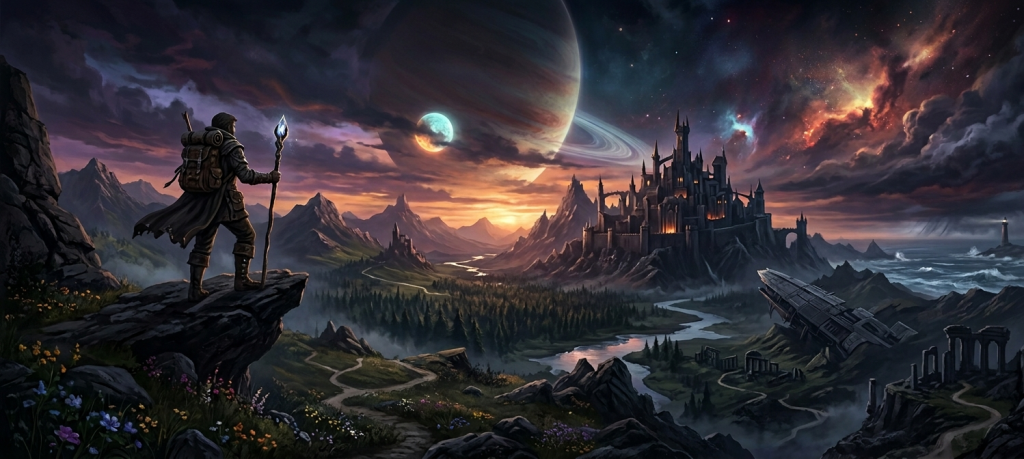
The air was cold and sweet. It didn’t taste like metal. It tasted like pine trees and wet dirt. The sky wasn’t green. It was a deep, dark purple, filled with stars that didn’t flicker.
Mick stood beside him. He took a long, shaking breath. He looked up at the moon. It was big and white and solid.
Hayes looked at his hands. They were covered in dirt and grease, but they were steady. He knew what he had to do now. He wasn’t going to map the ruins anymore. He was going to map the new world. He was going to find every forest that was still standing and every stream that was still running.
He looked at Mick and smiled. Mick smiled back. It was a rare thing, a victory that didn’t feel like a loss.
“Let’s go, Mick,” Hayes said. “I know the way.”
They walked away from the hole in the ground. Behind them, the wind started to blow through the dead grass. It made a sound like a long, happy sigh. Hayes didn’t need a compass to know where they were going. For the first time in a decade, the world felt like it belonged to them again. He could almost smell the grass growing. He could almost hear the birds waiting for the morning to break. It felt like being a kid again, waking up on the first day of summer. It felt like coming home.