

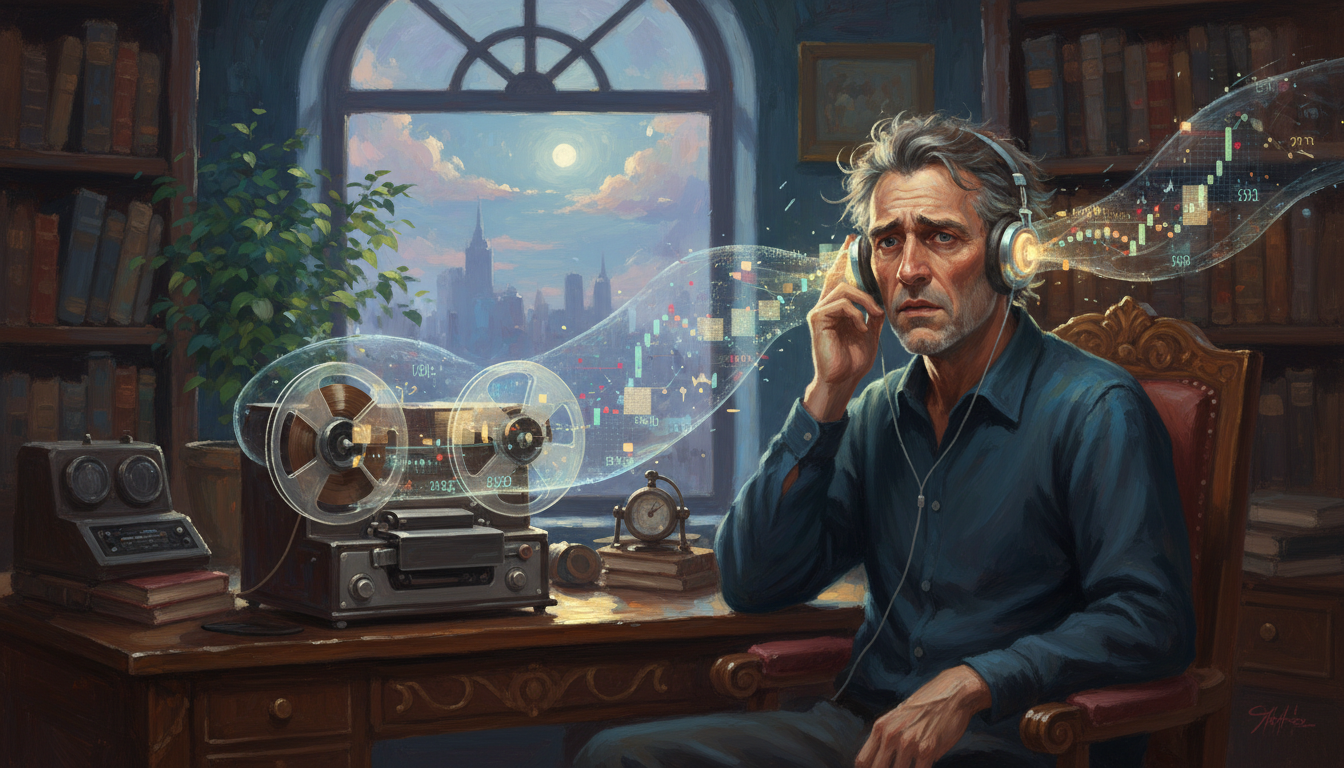
Jax used to be the only man in Manhattan who could make the stocks dance just by snapping his fingers. He was the king of the room: the velvet suit, the gold watch, the laugh that sounded like money hitting the floor. We all wanted to be him, or at least be seen with him. But lately, the king has been losing his crown. Not to a rival or a bad bet, but to the big blank in his own head. His memory is like an old silk shirt: it is beautiful, but it is falling apart at the seams.
I sat with him this morning in his penthouse. It smells like expensive cigars and the kind of leather you only find on private jets. Jax looked at me with those bright eyes, but I could tell he didn’t know if I was his best friend or his dry cleaner. He had this little silver recorder in his hand. He kept clicking it: on and off, on and off. He told me he found a file on his computer that scared him. It was his own voice, recorded months ago, talking about a plan to wreck the whole market.
He called it the Ghost Trade. It was a piece of math he built to eat the world. If he didn’t put in a secret code by nine in the morning, the machine would start selling everything. It was a suicide note written in numbers. He did it back when he was still sharp: back when he was afraid of becoming a man who couldn’t remember his own name. He wanted to go out with a bang that would make the history books shake. But now, sitting there in the morning light, he didn’t want to die. He wanted to remember how it felt to win.
We had forty minutes. Jax was sweating through his thousand dollar shirt. He kept looking at the screen and then at his hands. He looked like a kid trying to remember a poem for school. I told him stories to help. I reminded him of the night in 1999 when we bought out that entire club in Paris just because the wine was the right color. I reminded him of the time he sold short on that tech company and bought a boat the size of a hotel. I needed him to find that version of himself: the Jax who never lost.
The clock on the wall was ticking like a heart. Jax started typing. His fingers were shaking, but then they hit a rhythm. It was a beautiful thing to watch. It was like seeing a master piano player find the song again. He wasn’t looking at the screen anymore. He was looking at a spot on the wall, his eyes glassy with tears. He was seeing the old days. He was seeing the rallies and the cheers and the cold champagne. He was reaching back into the fog and pulling out the lightning.
He hit the last key with a loud snap. The screen turned green. The Ghost Trade was dead. He didn’t just stop the crash: he turned the trade around. He made a hundred million dollars in three seconds. He sat back in his chair and let out a long, shaky breath. He looked at me and for one second, the fog cleared. He really saw me. He smiled that old, wicked smile that used to make every woman in the room lean in a little closer.
We stood on the balcony as the sun came up over the park. The city was waking up, and nobody had any idea how close they came to losing it all. Jax held his coffee cup like it was a trophy. He told me he might forget this win by lunch time. He said his brain was like a chalkboard being wiped by a wet cloth. But he didn’t sound sad. He sounded like a man who had just played the best game of his life and knew he had one more story to tell.
I looked at him and felt that old ache in my chest. It was the feeling of a long summer evening coming to an end. We are all fading, darling. We are all losing pieces of ourselves to the wind. But for that one moment, Jax was the king again. He was the smartest, fastest, and richest man in the world. He beat the machine, and he beat the blankness. It was a triumph that tasted like old brandy and salt. It was the last great trade, and it was perfect.