

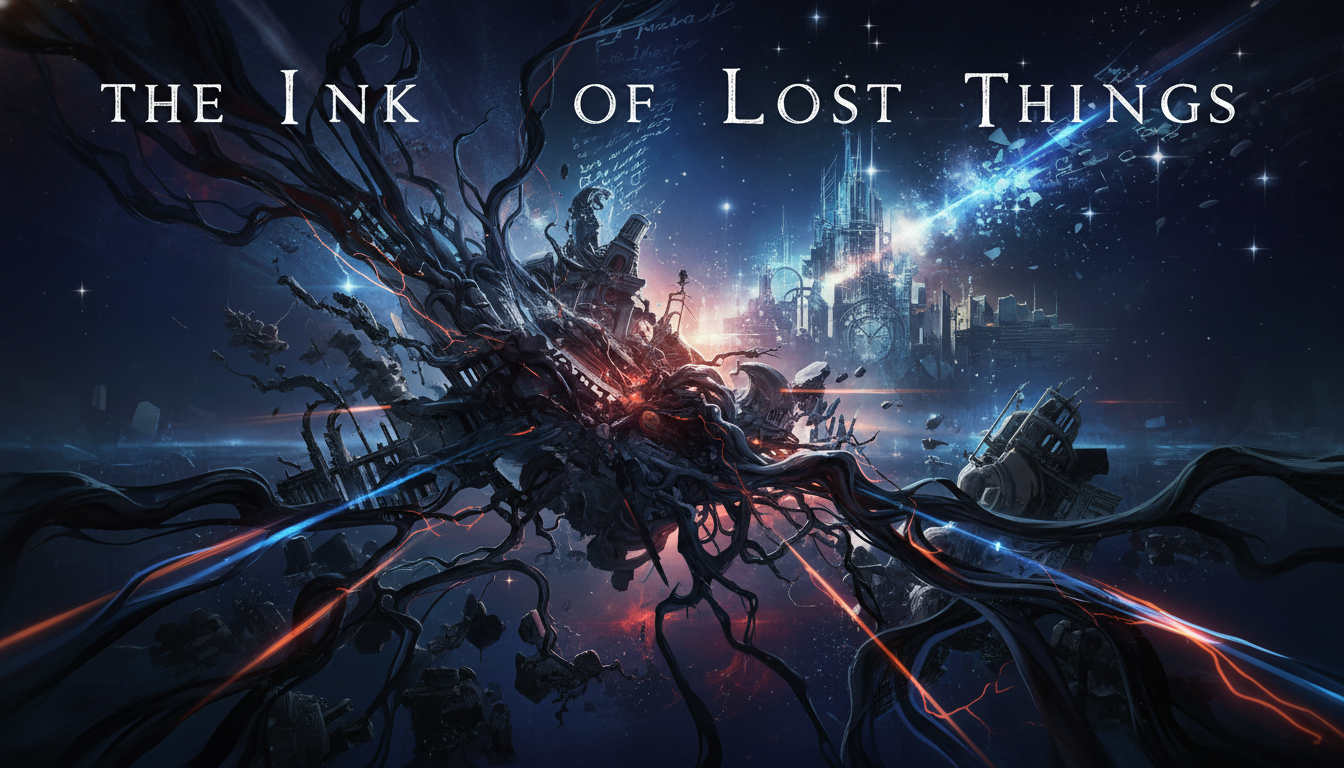
Gabe sat at a small, scarred desk in the basement of City Hall. His fingers were stained a permanent, bruised purple. Being an ink-mage was not like the stories. There were no glowing wands or velvet capes. It was mostly back pain and the smell of old vinegar. His job was simple: he wrote the laws that kept the city from falling into the sea. In this place, if a law was written in the Great Ledger, it became real. If Gabe wrote “No heavy trucks on Main Street,” the asphalt would literally reject the tires. It would push back like a grumpy mule.
He took a sip of lukewarm coffee that tasted like wet pennies. His heart felt like a piece of lead sitting in his ribs. It had been exactly one year since Mabel died. She was six years old. She liked to draw cats with six legs and eat the crusts off other people’s sandwiches. When she died, the City Council made Gabe write a law. They called it “The Act of Moving On.” They wanted to make sure the city stayed productive. The law made it illegal to dwell on the dead in public. As soon as Gabe inked the words, the cemetery grew a thick, thorny wall. The flowers on people’s porch steps turned to gray dust. The city got quiet: the kind of quiet that makes your ears ring.
Sy, the foreman, walked in. Sy was a man who looked like he was made of beef jerky and bad intentions. He slammed a folder onto Gabe’s desk.
“The sidewalk on Fourth Street is acting up,” Sy said. He picked at a piece of spinach in his teeth. “It’s turning into mud. People are getting stuck up to their knees. It’s a mess, Gabe. Fix it.”
Gabe looked at the map. Fourth Street was where the school used to be. It was where the bus had skidded on the ice. He felt a sharp, cold spike in his chest. “I wrote the paving laws last month, Sy. They’re solid. The ink was fresh.”
“Well, the ink is failing,” Sy barked. “The ground is soft. It’s like the street is crying or something. Just do your job and write a Reinforcement Act. Make it stiff. Make it like granite.”
Gabe waited until Sy left. He opened the Great Ledger. The paper was skin-warm and thick. But when he turned to the page where “The Act of Moving On” was written, the words were bleeding. The black ink was running down the page like tears. It wasn’t just fading: it was being pushed out.
He touched the page. The paper felt wet. Suddenly, a vision hit him. It wasn’t a magic vision. It was a memory. He saw Mabel’s red boots by the door. He saw the way she used to hum when she brushed her hair. The grief hit him like a physical blow to the stomach. He doubled over, gasping for air. The room felt like it was shrinking. He felt like a panicked pufferfish trying to breathe in a desert.
He left the basement and walked out into the city. It was worse than Sy said. The city was breaking.
On Fourth Street, the ground wasn’t just mud. It was shifting. The bricks were rearranging themselves. A pile of rubble was forming into the shape of a giant, jagged teddy bear. Down the block, a fountain that was supposed to spray clean water was bubbling with a dark, salty liquid. It smelled like the ocean and old sweaters.
People were standing around, looking confused and terrified. A woman named Vera was crying. She was leaning against a lamp post that was bending over like it wanted to hug her.
“My house,” Vera sobbed to Gabe. “The walls are turning into my mother’s old quilts. I can’t get the door open. It’s too soft.”
Gabe realized what was happening. You can’t just delete a feeling with a law. The grief of the whole city had been bottled up under the pavement. It had been pushed down by Gabe’s magical ink for a year. Now, the law was being erased by the sheer weight of their broken hearts. The city wasn’t just a place anymore: it was a map of everything they had lost.
He saw a crack in the middle of the street. He looked down into it. He didn’t see pipes or dirt. He saw a bedroom. It was Mabel’s bedroom. He saw her unmade bed and the half-finished drawing of a purple dragon on her nightstand. The city was pulling the things they missed out of the air and making them solid.
Gabe sat down on the curb. He felt very small. He could hear the city groaning. It sounded like a choir of people trying not to scream.
He pulled a small vial of ink from his pocket. It was the “Law-Breaker” ink. It was used to undo mistakes. He looked at the Great Ledger, which he had carried out with him. He saw the “Act of Moving On” shivering on the page.
If he erased the law, the wall around the cemetery would fall. The gray dust would turn back into flowers. But the pain would come back, too. It would hit everyone at once. They would remember the smell of the hair and the sound of the laughs. They would be useless for weeks. The city would stop.
Gabe thought about Mabel’s red boots. He thought about how he hadn’t touched them in a year because the law said he had to be “productive.” He felt like his soul was a card table that had finally folded.
“I’m sorry,” Gabe whispered.
He didn’t write a new law for granite. He didn’t make the ground stiff. Instead, he took his pen and scratched a line through the Act of Moving On. He did it slowly.
The reaction was instant.
The sky turned the color of a fresh bruise. A wind blew through the streets, carrying the scent of funeral lilies and baby powder. All over the city, people dropped to their knees. They weren’t screaming. They were finally, deeply quiet.
The mud on Fourth Street didn’t turn back into bricks. It stayed soft, but it stopped being a trap. It turned into a garden of wild, tangled weeds. The jagged teddy bear of rubble softened into a mound of moss.
Gabe felt the lead in his chest crack open. It didn’t go away, but it felt lighter. It felt like something he could carry.
Sy came running out of City Hall. He was red-faced and sweating. “What did you do? The walls in the lobby are covered in pictures of my ex-wife! The Mayor is weeping into a bucket! The streets are a mess!”
Gabe looked up at him. His eyes were red, but for the first time in a year, they were clear. “The law was a lie, Sy. You can’t pave over a hole in the heart. It just makes the hole deeper.”
Sy looked like he wanted to yell, but then he stopped. He looked at the ground. He looked at the soft, mossy mound that used to be a pile of trash. His shoulders slumped. He sat down next to Gabe on the curb.
“She used to make the best lemon cake,” Sy whispered. His voice was thick. “My wife. She’s been gone five years. I forgot what the lemons smelled like until five minutes ago.”
They sat there together. Two grown men on a curb in a city that was slowly falling apart. The buildings were leaning in, the roads were wavy, and the park was full of ghosts. It was a disaster. It was a wreck.
But as Gabe watched the thorns fall off the cemetery wall in the distance, he realized the city was finally honest. It was a place of ruins and memories. It was broken, just like them. And for the first time since the bus skidded on the ice, Gabe didn’t want to go back to the basement. He just wanted to sit in the rain and remember his daughter’s six-legged cats.