
Sutton sat in the back of his father’s old workshop. The air smelled like lemon oil and stale coffee. On the workbench sat a brass bird. It was beautiful, but it was dead. Sutton’s father, Hayes, could make these birds sing with a single turn of a key. Sutton could only make them click and jam. He was a clockmaker who couldn’t keep time.
The village of Oakhaven was fading. It wasn’t a disease or a war. It was the time itself. Sometimes a Tuesday would last for forty hours. Other times, the sun would jump from morning to night in a blink. People were losing their memories because the moments didn’t stick anymore. Sutton’s sister, Tasha, had forgotten his name twice yesterday. The fear in her eyes felt like a cold blade pressed against his ribs. He had to fix the world, even if he couldn’t fix a watch.
He picked up a heavy wrench and tapped the brass bird. He wasn’t trying to be gentle anymore. He was angry. The bird’s chest plate popped open. Inside, tucked behind the tiny gears, was a piece of parchment. It was thin and soft, like a dried leaf. It wasn’t a blueprint. It was a map.
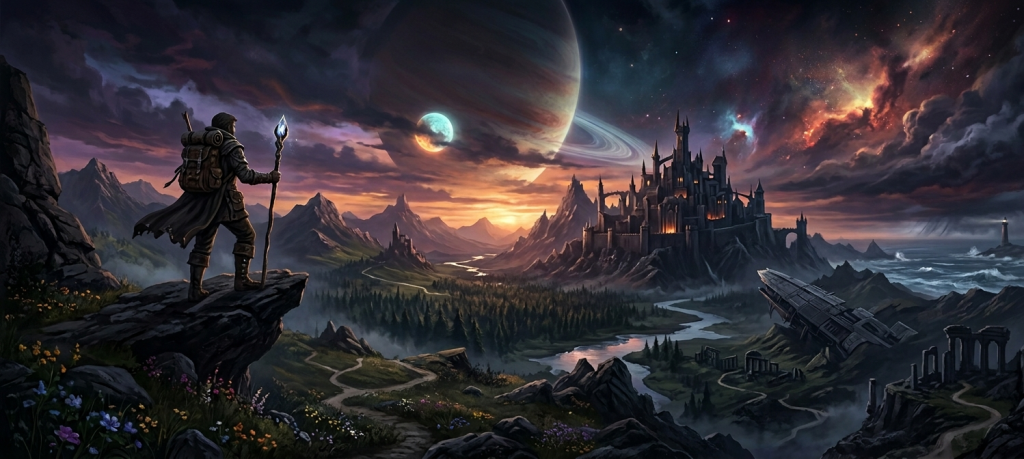
The map showed a sea that didn’t exist on any chart. It showed a group of islands that only rose when the moon turned the color of a bruised plum. This happened once every hundred years. The map called it the Shifting Chain. At the center of the islands sat the Great Clock. Sutton felt a sudden, sharp heat in his throat. This was his father’s secret. Hayes hadn’t been a lucky man: he had been a traveler.
The lunar eclipse began three nights later. Sutton didn’t have a grand ship. He had a small rowboat named the Cricket. He pushed off from the shore as the moon began to bleed red. The water didn’t splash. It hummed.
The first island rose from the waves like a whale breaking the surface. It was covered in silver moss and trees that looked like giant springs. Sutton’s heart hammered against his teeth. He felt small. He felt like a boy wearing his father’s oversized boots. But then he saw it. A trail of rusted gears led into the center of the island.
The islands were moving. One moment the path was straight, and the next it was a cliff. Sutton had to jump across gaps where the sea roared like a hungry animal. He scraped his palms until they bled. He lost his boots to a patch of sticky mud. His chest ached with every breath, but he didn’t stop. He thought of Tasha. He thought of the way she used to braid his hair and tell him stories about the stars. He couldn’t let those stories vanish.
He reached the center of the chain just as the moon turned a deep, dark crimson. The Great Clock was not a building. It was a tree made of gold and iron. Its roots were huge copper pipes. Its leaves were shimmering silver discs. But the tree was silent. A thick, black vine of soot had choked the main gear at the base of the trunk.
Sutton climbed. The metal was cold and slick. He slipped twice, catching himself on a branch made of brass wire. His fingers were numb. He reached the black vine and pulled. It didn’t budge. It felt like cold stone.
He realized then why his father had never told him about this place. You couldn’t fix the Great Clock with a wrench. You had to give it something that mattered.
Sutton reached into his pocket. He pulled out the only thing he had left of his father: a small, silver pocket watch. It didn’t work. It had stopped the moment Hayes died. It was a heavy weight of grief that Sutton carried every day. It was his most precious sorrow.
“I don’t want to hold onto the end anymore,” Sutton whispered. His voice was small in the vast, ticking forest.
He jammed the silver watch into the teeth of the main gear. He used it as a wedge. He pushed with everything he had. His muscles screamed. His vision blurred with tears. With a sound like a mountain cracking, the black vine snapped.
The silver watch was crushed instantly. The gears began to turn.
A sound erupted from the tree. It wasn’t a mechanical grind. It was a chord. It sounded like a thousand church bells ringing at once. It sounded like a mother’s laugh and the first rain of summer. The gold and iron branches began to glow with a warm, amber light.
The islands began to sink back into the sea, but Sutton wasn’t afraid. The water felt like a warm blanket. The light from the tree wrapped around him. He felt a sudden, golden rush of every good thing he had ever known. He remembered the smell of his father’s woodshop. He remembered the taste of the blackberries Tasha used to find in the woods.
When Sutton woke up, he was lying on the beach of Oakhaven. The sun was rising. It wasn’t jumping or skipping. It moved with a slow, beautiful grace.
He walked into the village. People were standing in the street, blinking at the morning light. He saw Tasha standing on their porch. She was holding a mug of tea, and the steam curled in the air. When she saw him, her face broke into a smile that could have lit up the dark side of the moon.
“Sutton!” she shouted.
She remembered.
He ran to her and hugged her so hard his ribs creaked. He didn’t have his father’s silver watch anymore. He didn’t have his boots. His hands were scarred and his clothes were ruined. But for the first time in his life, Sutton knew exactly what time it was. It was the present. And it was perfect.
He went back into the workshop that afternoon. He didn’t pick up a wrench. He just sat in the sunlight and watched the dust dance. The brass bird on the table didn’t sing, but it didn’t look dead anymore. It just looked like it was waiting for a story. Sutton started to tell it.