

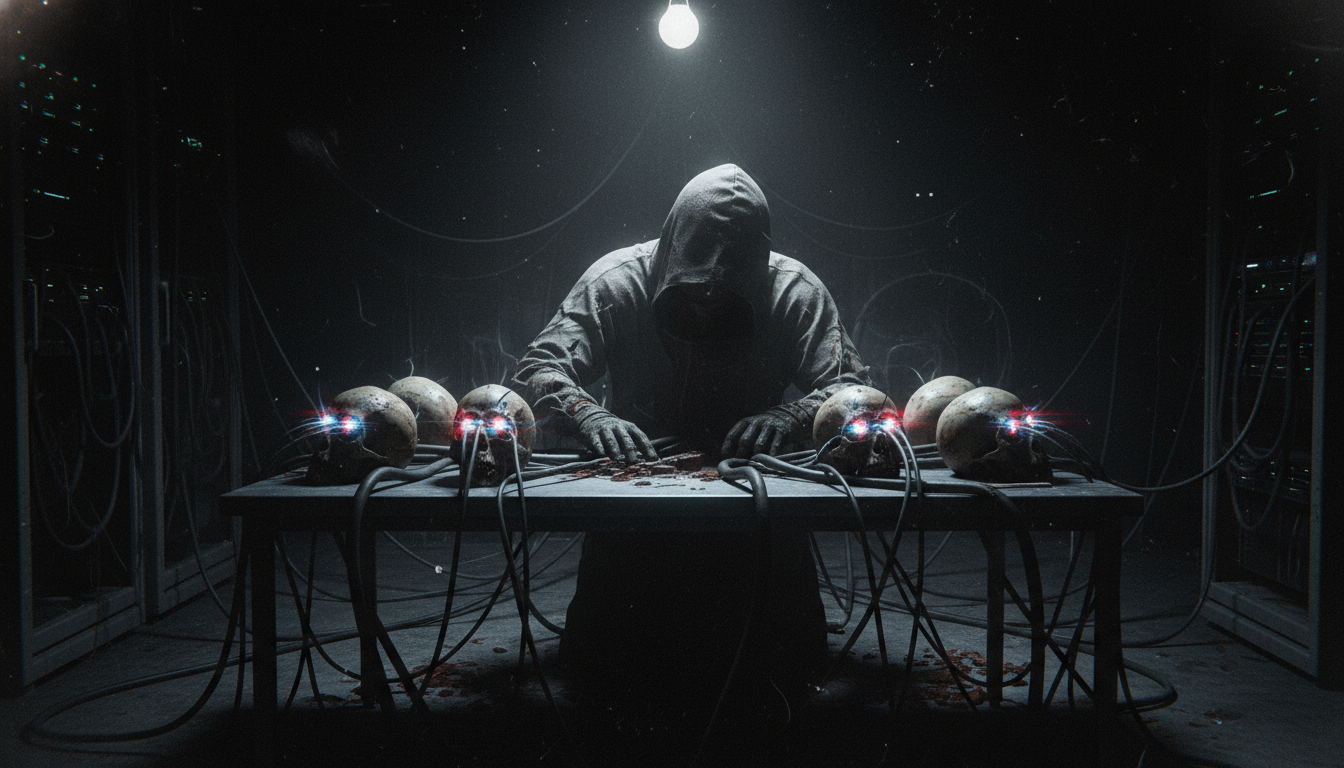
Hank sat in a room that smelled like old copper and burnt plastic. The light from his screen was a cold, sharp blue. It bit at his eyes. It bit at his skin. Hank was a man who killed ghosts. That was his trade. That was his burden. He reached into the digital minds of the dead, and he pulled out their pictures, and he threw them into the dark.
The regime said it was for the best. They said a clean mind made a happy city. They told the people that memories were heavy things. They said memories were like stones that pulled a swimmer under the waves. So, when a person died, Hank was the one who cut the stones loose. He was the one who let the bodies float.
Hank was lonely. His own heart felt like a hollow drum. He lived in a tiny box of a room with one chair and one plate. He could not remember the smell of rain. He could not remember the warmth of a hand. He only knew the hum of the machines.
One Tuesday, Hank opened the file for a man named Saul. Saul had lived to be ninety. That was a long time to gather stones. Hank clicked his mouse. He moved his fingers across the glass. He saw a flash of light.
It was a porch. A wooden porch with peeling white paint. There was a screen door. In the memory, the door swung open and then shut. *Whack.* It was a sharp, wooden sound. It was a sound Hank felt in his teeth. Then, he heard a laugh. It was a girl’s laugh. It was bright and clear like a bell in the morning.
Hank’s chest went tight. A sudden coldness spread through his ribs. He had never heard a sound like that. He had never seen a porch. The city was made of steel. The city was made of silence.
He was supposed to hit the button. He was supposed to click “Scrub.” But his finger shook. He felt a sting in his eyes. He closed the file and opened the next one.
The next file belonged to a woman named Della. She was young. She had died in a crash. Hank reached into her mind. He expected to see the neon lights of the city. He expected to see the gray walls of the factories.
Instead, he saw the porch.
The white paint was peeling. The sun was setting, and the air was thick with the smell of cut grass. *Whack.* The screen door slammed. The girl laughed. It was the same laugh. It was the same porch.
Hank leaned back. The silence in his office was heavy: it sat on his shoulders like a wet coat. He felt his heart thumping against his shirt. He was a small-town man in a big-city machine, and he knew he had found a secret. The regime told everyone they were alone. They told everyone their dreams belonged only to them. But Saul and Della had shared a world. They had shared a home that didn’t exist anymore.
He opened more files. He worked fast. His breath came in short, jagged bursts. He opened Knox. He opened Sia. He opened Jade.
And there it was. In every single one of them.
Deep under the layers of digital junk, there was a hidden place. It was a memory that didn’t belong to any of them, and yet, it belonged to all of them. It was a shared dream of a world with green trees and wind that tasted like salt. It was a world where people sat together on wooden steps and watched the stars. They weren’t isolated. They weren’t alone. They were connected by a golden thread of yesterday.
Hank looked at the “Scrub” button. It was a big, red circle. If he pushed it, the porch would vanish. The screen door would never slam again. The girl’s laugh would go silent forever. The regime would win. The people would stay in their little boxes, thinking they were the only ones who ever felt a soul-deep ache for something more.
His hand hovered over the glass. He thought about his own empty room. He thought about the red tricycle he saw in Sia’s mind. He thought about the way Saul’s memory of the sun felt warm on his own neck.
The monitors on the wall started to beep. The system knew he was idling. The regime was watching. They wanted the ghosts dead. They wanted the static cleared.
But Hank felt something new. It was a spark. It was a fire. It was a memory of a mother he never knew, or maybe a mother everyone knew. He felt a deep, soulful need to keep that screen door swinging. He wanted to feel the splinters of that wooden porch under his feet.
He didn’t hit the “Scrub” button.
Instead, Hank began to type. He used the codes he wasn’t supposed to know. He moved the shared memory. He didn’t delete it. He copied it. He pushed it out. He sent it like a letter into the neural implants of the living. He broadcast the porch. He broadcast the grass. He broadcast the laugh.
He felt the “Torment” of the risk. His heart was expanding like a panicked pufferfish. He knew they would come for him. He knew the doors would burst open and the men in gray suits would take his chair and his plate.
But as he worked, he saw the lights of the city outside his window. For the first time, they didn’t look like cold eyes. They looked like stars.
He sent the file to Jules. He sent it to Cade. He sent it to Hattie.
All across the city, people stopped. In their sterile apartments and their gray cubicles, they paused. They felt a sudden warmth on their skin. They heard a wooden thud. *Whack.* They heard a girl laugh. They remembered a home they had never been to, but had always missed.
Hank sat back. He let his hands fall to his sides. He closed his eyes.
The door to his office hissed open. He heard the heavy boots of the guards. He felt the cold air of the hallway rush in. But he wasn’t afraid. He wasn’t lonely.
He could see the porch. He could smell the grass. He was sitting on the steps with Saul and Della and all the others. He was finally home.
And as the guards grabbed his arms, Hank smiled. He knew the secret was out. You can burn the books. You can scrub the wires. You can kill the man. But you cannot stop the echo. The echo lives in the static. The echo lives in us all.