

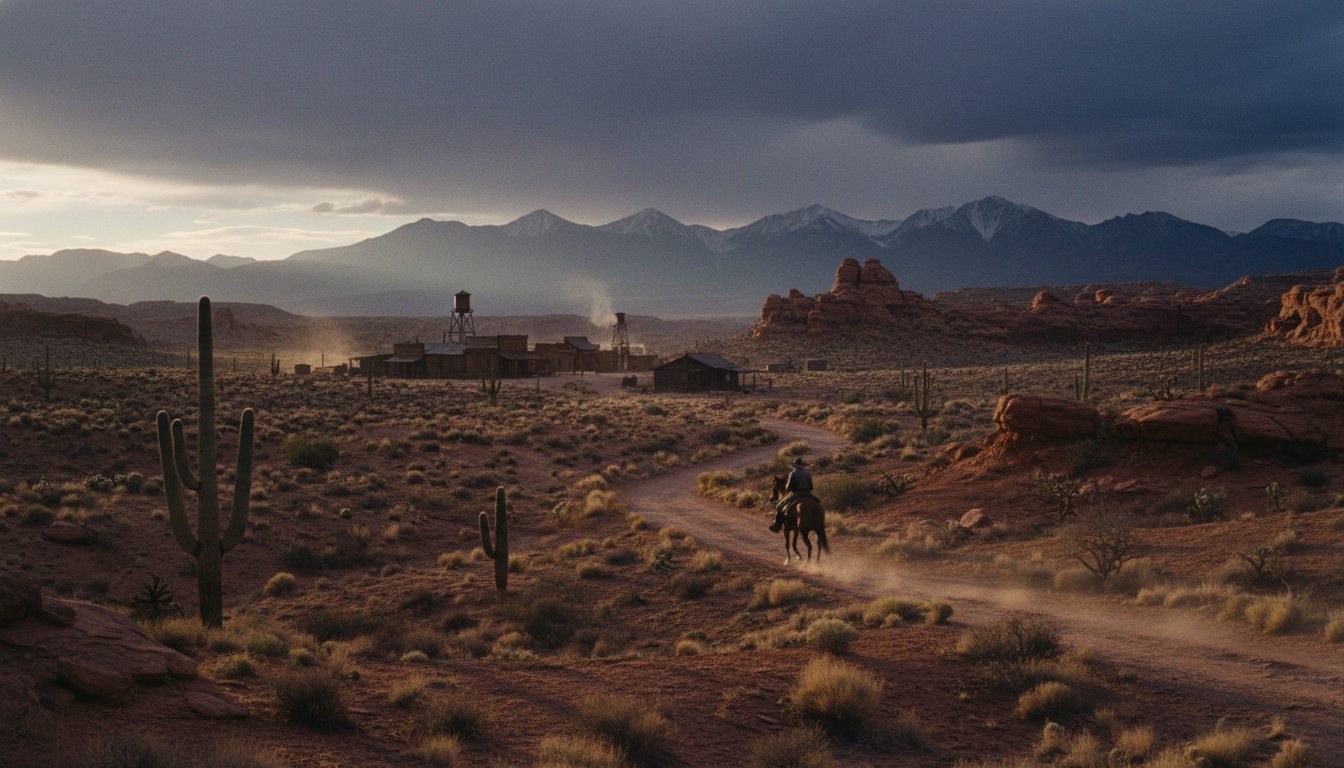
Leo was seventy years old and smelled like a wet dog that had been rolled in tobacco. He sat on the porch of the ranch house: a building that was mostly held together by spiderwebs and stubbornness. In his hand, he held a piece of paper from the bank. It was yellow and crinkled. It said the bank was going to take the dirt and the cows and the house in three weeks.
Vera stood next to him. She was his granddaughter, and she looked like she belonged in a painting, not a dust bowl. She wore a silk dress the color of a robin’s egg. Her shoes were thin and pretty and entirely useless for walking on anything but a rug. She had spent the last ten years in the city learning how to play the piano and drink tea with her pinky finger out. Now, she was staring at a dead cactus like it was a monster from a storybook.
“Grandpa,” Vera said. Her voice was high and sharp. “There is a lizard in my trunk. A very large, very rude lizard.”
Leo didn’t look up from the bank notice. “That’s just Pete. He likes the shade. You want to save this ranch, or you want to talk to the reptiles?”
Vera looked at her fancy suitcases. She looked at the peeling paint of the porch. Her grandmother, Dottie, had died two years ago, and the place had gone to rot. Leo had spent his life as a U.S. Marshal, catching bad men and getting shot in places that made him limp when it rained. He was a hero to the newspapers, but he was a failure to the bank.
“I came here because you said there was an inheritance,” Vera said. She tucked a stray hair behind her ear. “I did not come here to live in a dust cloud with a man who hasn’t used soap since the Great Flood.”
Leo finally looked at her. His eyes were like two pieces of flint. “The inheritance is that dirt out there. It’s been in our family for four generations. If we don’t get three thousand dollars by the end of the month, the bank man gets it. And I ain’t letting a man in a pinstripe suit take Dottie’s rose garden.”
“The roses are dead, Grandpa,” Vera pointed out.
“They’re resting,” Leo barked. He stood up. His knees made a sound like dry sticks breaking. “Grab your hat. We’re going hunting.”
“Hunting for what? A miracle?”
“Better,” Leo said. “We’re hunting Sloane.”
Vera blinked. Even in the city, people knew that name. Sloane was an outlaw who had robbed three trains and a wedding party. He was famous for two things: his red beard and his ability to vanish like smoke. There was a bounty on his head for exactly three thousand dollars.
“He’s a murderer!” Vera hissed.
“He’s an investment,” Leo corrected. “And I know where he’s hiding. He’s at the Old Well. He’s sick, Vera. My old deputy told me Sloane’s got the lung fever. He’s dying. All we got to do is pick him up and drive him to the jail in Miller’s Creek. It’s a three day trip. Easy as peeling a potato.”
Vera looked at her silk dress. She looked at the dry, orange horizon. She thought about her tiny apartment in the city and the way the landlord knocked on her door every morning.
“If I do this,” Vera said. “I want the master bedroom. And I want a bathtub that isn’t a bucket.”
“Deal,” Leo said.
They found Sloane two hours later. He wasn’t hard to find because he was coughing so loud it scared the crows. He was sitting against a rock at the Old Well, clutching a rusty rifle. When he saw Leo, he tried to lift the gun, but it fell out of his hands. He looked like a man who had been chewed up by a coyote and spit out into a patch of cactus.
“Leo,” Sloane wheezed. His face turned a shade of purple that was almost impressive. “You come to kill me?”
“I come to collect you, you old goat,” Leo said. He kicked the rifle away. “You look terrible.”
“I feel worse,” Sloane said. He looked at Vera. He squinted his watery eyes. “Who’s the doll? You kidnapping city girls now?”
“She’s my muscle,” Leo said.
Vera stepped forward. She was holding a heavy iron skillet she had taken from the kitchen. She held it like a weapon. “I am the granddaughter. And if you get any dirt on my shoes, Mr. Outlaw, I will clatter your head like a bell.”
Sloane let out a shaky laugh that turned into a wet, rattling cough. “I like her. She’s got vinegar.”
They loaded Sloane into the back of Leo’s old wagon. It was a rickety thing that creaked with every step the horse took. The heat was like a physical weight. The sun sat in the sky like a big, angry orange.
“I’m dying,” Sloane announced about ten miles into the trip. “I can feel the Reaper. He’s wearing a hat. He’s got a scythe.”
“Shut up, Sloane,” Leo said. He was driving the wagon, squinting against the glare.
“I have a final wish,” Sloane gasped. He reached out a trembling hand toward Vera. “A dying man’s request. It is a sacred thing.”
Vera looked suspicious. “What is it?”
“A peach,” Sloane whispered. “A cold, juicy peach. If I could just taste a peach, I could die in peace.”
“We are in the middle of a drought in the middle of a desert,” Vera said. “The only thing juicy out here is the spit in your mouth. Drink some water.”
“Heartless,” Sloane moaned. He flopped back onto the straw. “To die without a peach. What a world.”
The first night was the hardest. They camped under a sky so full of stars it looked like someone had spilled salt on a black velvet coat. Leo’s back hurt. Vera’s feet were blistering. Sloane spent the whole night describing, in great detail, every meal he had ever eaten.
“And then there was the pot roast,” Sloane said to the stars. “The gravy was so thick you could use it to glue a shoe together. The carrots were soft. The onions were sweet.”
“If you don’t stop talking about gravy,” Leo growled from his bedroll. “I will shoot you myself and take a pay cut.”
Vera sat by the small fire. She was trying to clean the dust out of her fingernails with a twig. She looked at Leo. He looked older in the firelight. His hands were shaking just a little bit.
“Grandpa?” she asked softly.
“What?”
“Why didn’t you ever come visit me in the city? After the funeral?”
Leo was silent for a long time. The only sound was the crackle of dry brush in the fire and Sloane’s rhythmic snoring.
“I didn’t want you to see the ranch like this,” Leo finally said. “And I didn’t want you to see me like this. A lawman without a badge. A farmer without a crop. I’m just a man sitting in the dust, Vera.”
Vera looked at her broken nails. She looked at her ruined dress. “I didn’t care about the ranch. I just wanted to see you.”
Leo didn’t answer, but he reached over and patted her hand. His palm was as rough as sandpaper. It was the first time he had touched her in years. It felt like a bridge being built.
The next morning, things went wrong. They were crossing a dry creek bed when the wagon wheel hit a rock with a loud *crack*. The wagon tilted. Sloane rolled out of the back like a sack of beans and landed face-first in the sand.
“My ribs!” Sloane yelled. “The Reaper has arrived! He’s kicking me in the ribs!”
Leo jumped down. He looked at the wheel. It was snapped clean through. He looked at the horse, then at the horizon. They were still ten miles from Miller’s Creek.
“We have to walk,” Leo said.
“I can’t walk!” Sloane protested. He sat up, covered in orange dust. “I am a delicate flower of a man! I am fading! My soul is departing!”
Vera marched over to him. She grabbed him by the collar of his greasy coat and hauled him to his feet. She was surprisingly strong for someone who played the piano.
“You are going to walk,” Vera said. Her voice was steady and terrifying. “You are going to walk because my house is at the end of this road. You are going to walk because I am tired, and I am hungry, and I am wearing silk in a sandstorm. If you stop moving, I will use that skillet on you. Do you understand?”
Sloane stared at her. He blinked. “Yes, ma’am.”
They walked. Leo led the horse. Vera pushed Sloane. Sloane complained about his lungs, his feet, and the lack of peaches.
The heat was brutal. It felt like the air was made of wool. Vera’s face was burned red. Her dress was torn at the hem. She didn’t look like a city girl anymore. She looked like a pioneer. She looked like Dottie.
Around noon, they saw a cloud of dust behind them.
“Company,” Leo said. He pulled his old revolver from his belt.
Three men on horses appeared. They weren’t lawmen. They were wearing dirty ponchos and had mean, hungry looks on their faces. The man in the lead had a scar across his nose that made him look like he was always snarling.
“That’s Zane,” Sloane whispered. He had stopped complaining and looked genuinely scared. “He’s my old partner. He ain’t here to rescue me. He’s here because he thinks I buried the gold from the train job.”
Zane rode up and circled them. He looked at Leo’s old gun and laughed. It was a dry, nasty sound.
“Give us the sick man, old timer,” Zane said. “And maybe we let you keep the girl.”
Leo stepped in front of Vera. His back was straight. The limp was gone. He looked like the Marshal people used to tell stories about. “This man is in my custody. You want him, you go through me.”
Zane pulled his own gun. “That can be arranged.”
Vera didn’t think. She didn’t have time to be scared. She saw a heavy rock on the ground. She picked it up. As Zane leveled his pistol at her grandfather, Vera screamed at the top of her lungs. It wasn’t a lady-like scream. It was a war cry. She threw the rock with every bit of anger she had toward the bank, the drought, and the broken wagon.
The rock hit Zane’s horse right in the ear. The horse flared up, whinnying in surprise. Zane’s shot went wild, hitting a cactus.
Leo didn’t miss. He fired once. The bullet hit Zane’s shoulder, knocking him clean off his horse. The other two men looked at Zane on the ground, then they looked at Leo, who was already aiming at the next one. Then they looked at Vera, who was reaching for another rock.
They turned their horses and bolted. They weren’t paid enough to fight a crazy old man and a girl with a rock.
Leo stood there, breathing hard. He looked at the gun in his hand, then at Vera.
“Nice throw,” he said.
Vera was shaking, but she was smiling. “He was going to hurt you.”
“I think you broke his horse’s spirit,” Sloane said from the ground. He looked impressed. “Remind me never to get on your bad side, kid.”
They reached Miller’s Creek just as the sun was beginning to dip. The town was small: just a few buildings and a lot of hitching posts. They marched Sloane right into the Sheriff’s office.
The Sheriff was a young man with a shiny badge and a clean shirt. He looked at the dusty, battered trio in front of him.
“I’m Leo Miller,” Leo said, dropping his gun belt on the desk. “I’m here for the bounty on Sloane.”
The Sheriff looked at Sloane. “You caught him? He’s been missing for a year.”
“He wasn’t missing,” Sloane said, leaning against the wall. “I was just resting. And I’d like to go to jail now. They have beds in jail. And maybe peaches.”
The Sheriff checked his books. He pulled out a heavy wooden box and started counting out stacks of bills. One thousand. Two thousand. Three thousand.
Leo took the money. He looked at it for a long time. This was the house. This was the legacy. This was the rose garden.
“Wait,” Vera said. She looked at Sloane. The outlaw was sitting in a chair, looking smaller than he had two days ago. He was still coughing. He looked lonely.
Vera turned to the Sheriff. “Is there a doctor in this town?”
“Sure,” the Sheriff said. “Doc Frankie is right across the street.”
Vera took a twenty dollar bill from Leo’s hand. Leo didn’t complain. She walked over to Sloane and put the money in his pocket.
“For the peaches,” she said.
Sloane looked up at her. He didn’t say anything, but he nodded. For a second, he didn’t look like an outlaw. He just looked like a man who was glad to be seen.
Leo and Vera walked out of the office and into the cool evening air. The drought hadn’t broken, but the wind felt a little softer.
“We should get a hotel,” Leo said. “And a steak. A big one.”
“And a bath,” Vera added. “A very long, very hot bath.”
They sat on the bench in front of the Sheriff’s office. Leo reached into his pocket and pulled out a small, crumpled paper. It wasn’t the bank notice. It was a photograph of Dottie.
“She would have liked you,” Leo said. “She was a fighter too.”
Vera leaned her head on his shoulder. She didn’t care about the dust on her dress or the blisters on her feet. She looked down the street and saw a general store. In the window, there were crates of supplies.
“Grandpa,” she said. “When we get back to the ranch, I want to learn how to fix that wheel. And I want to learn how to shoot. Not because I want to kill anyone, but because I’m pretty good at hitting things.”
Leo laughed. It was a deep, warm sound that filled his chest. “I think we can manage that. But first, the steak.”
As they walked toward the restaurant, a fat raindrop hit the brim of Leo’s hat. Then another hit Vera’s nose. Within a minute, the sky opened up. It wasn’t a drizzle: it was a flood. The dust turned to mud instantly. The smell of wet earth rose up, sweet and heavy.
Vera looked up at the clouds and started to laugh. She spun around in her ruined silk dress, letting the water soak her to the bone. Leo stood there, letting the rain wash the tobacco and the dirt off his face.
They were going home. The house was theirs. The roses would grow back. And for the first time in a long time, the dirt didn’t feel like a burden. It felt like a beginning.