
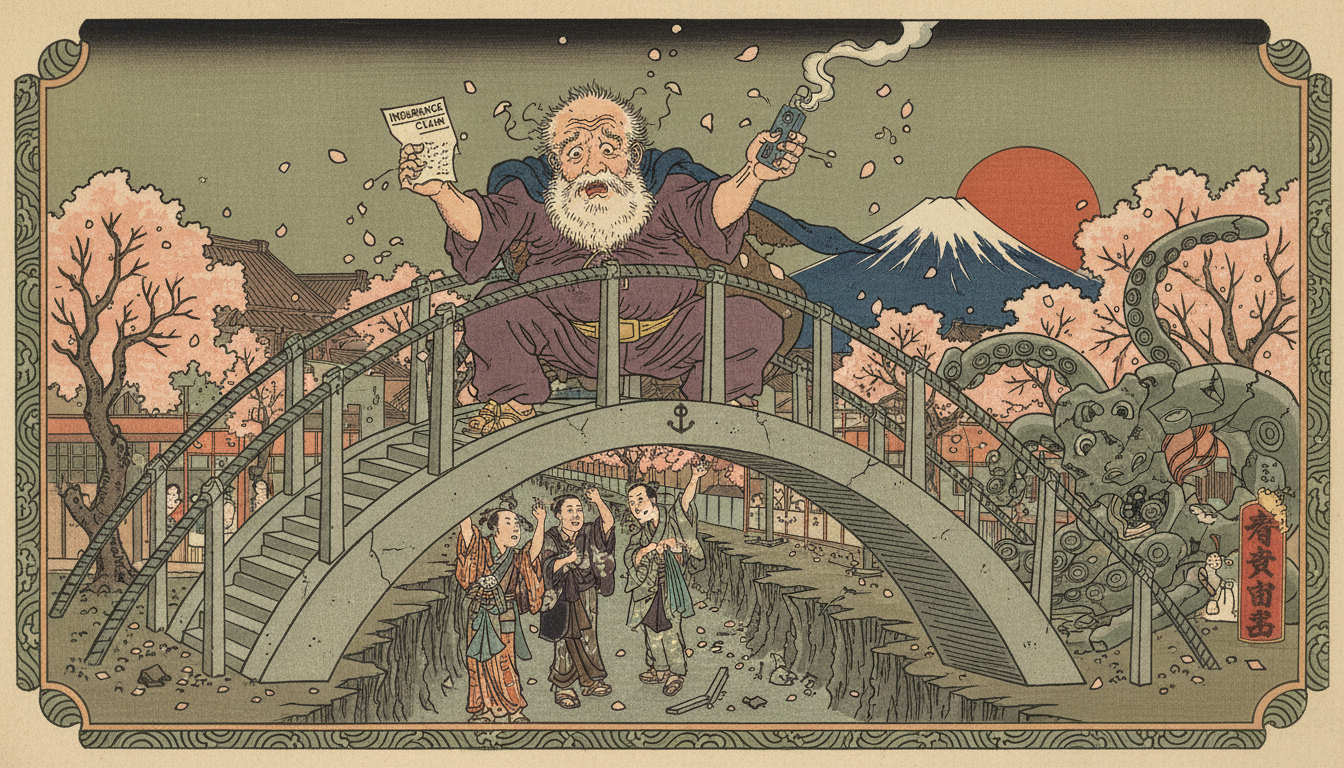
Hank sat on a plastic crate in his kitchen and stared at a leaky pipe. He was seventy years old. His skin looked like a crumpled brown paper bag that had been stepped on. For forty years, people called him “The Shadow.” He used to wear a cape that smelled like mothballs and stale cigarettes. He tried to steal the city’s moon once. It didn’t work. Mostly, he just tripped over his own boots and got punched by guys in spandex. Now, he was just a guy with a bad hip and a house that was literally falling into the dirt.
He needed the insurance money. He needed it bad. His bank account was a desert. His vital need was simple: he wanted to retire to a place where the air didn’t smell like wet dogs and diesel. To get there, he had to destroy his own home. He had to make it look like an accident. He was a villain, after all. Doing the wrong thing should have been easy.
Hank grabbed a wrench. He had a plan to loosen the main gas valve just enough. He wanted a small fire. Just a little one. Enough to char the rafters and trigger a total loss claim. He leaned his weight into the metal tool. His joints popped like dry sticks.
“Hank? You in there?”
It was Maury. Maury lived next door. He was eighty and had ears like giant dried apricots. He didn’t wait for an answer. He just pushed the back door open. Maury was holding a plate of lemon bars.
“I smelled something weird,” Maury said. He sniffed the air with a nose that had seen too many winters. “You got a leak, Hank? I can smell it from the sidewalk. It smells like rotten eggs and death.”
Hank froze. He had the wrench locked onto the valve. If he turned it now, Maury would see. But then he looked at Maury’s face. Maury’s eyes were watery. He looked scared.
“I think it’s coming from your basement, Maury,” Hank lied. He dropped the wrench into a bucket of mops. He felt a sharp jab of guilt in his gut. It felt like a cold fish wiggling in his chest. “Let me go look.”
Hank followed Maury next door. He wasn’t trying to be a hero. He just didn’t want the old man to blow up before Hank had a chance to burn his own place down. He went into Maury’s basement. It was a tomb of old newspapers and jars of screws. In the corner, the water heater was hissing. It wasn’t just gas. It was a massive, high-pressure leak that was seconds away from turning the whole block into a crater.
Hank didn’t think. He dove behind the heater. He grabbed a heavy rag and jammed it into the crack. He twisted a valve with his bare hands. He used his “villain” strength, the kind you only get when you spent years trying to rip vault doors off their hinges. The metal groaned. The hissing stopped.
“You fixed it!” Maury cheered. He patted Hank on the back. “The city should give you a medal. You saved the whole street, Hank.”
Hank looked at his greasy hands. He felt sick. He had just saved twelve houses. That was twelve houses he couldn’t use as “collateral damage” for his insurance fire. He went back to his own kitchen and sat in the dark. He was a failure at being a failure.
The next morning, Hank decided to try a different path. He was going to stage a robbery. He would “lose” his vintage collection of silver spoons and his old heist equipment. He went to the bank to withdraw his last fifty dollars to buy a crowbar.
He stood in line behind a woman named Lana. She was young and wore a coat that was missing three buttons. She looked like she hadn’t slept since the turn of the century. Hank was busy thinking about how to break his own front window without getting glass in his shins.
Suddenly, the front door of the bank kicked open.
A man named Vince ran in. Vince was a professional. He had a real gun and a mask that looked like a pig’s face. He started screaming about bags and money. The air in the bank got heavy and hot. People hit the floor like sacks of potatoes.
Hank didn’t move. He was annoyed. This guy was ruining his morning. He had a schedule. He had a crowbar to buy.
Vince pointed the gun at Lana. Her hands were shaking so hard she dropped her purse. Hank saw the look in her eyes. It was the same look his mother used to have when the landlord came knocking. It was a deep, quiet terror.
Hank reached into his coat. He still had his old “smoke pellets.” They were thirty years old. They were mostly just chalk and bad chemicals. He threw one at Vince’s feet.
The pellet didn’t explode. It just went *thwack* and rolled across the tile. Vince looked down at it. He started to laugh. It was a mean, jagged sound.
“What’s that, Gramps? You throwing rocks at me?”
Hank sighed. He stepped forward. He tripped on the rug. His hip gave out with a loud *crack*. He fell forward like a collapsing card table. His heavy, bony shoulder slammed right into Vince’s kneecap.
Vince let out a bark of pain. He folded. As he went down, his head hit the edge of the teller’s counter with a sound like a hammer hitting a pumpkin. He was out cold.
Lana looked at Hank. The whole bank looked at Hank.
“You tackled him!” Lana whispered. She hugged her purse to her chest. “He was going to hurt us, and you took him down!”
“I tripped,” Hank said. His hip was screaming. “I just wanted to get my fifty bucks.”
The police showed up. A guy named Troy, a cop with a neck thicker than a fire hydrant, shook Hank’s hand. He called the local news. By noon, Hank’s face was on every screen in the city. They called him “The Senior Sentinel.”
Hank went home and locked his door. He felt like he was being hunted by good luck. Every time he tried to do something selfish, the world twisted it into a miracle. He was seventy years old and he just wanted to be a crook so he could afford a decent bed and some soft shoes.
A week later, he reached his breaking point. He was going to finish it. He bought five gallons of gasoline. He poured it all over his living room. He didn’t care about the neighbors anymore. He didn’t care about the news. He was going to light a match and walk away.
He stood in the center of the room. The smell of the gas was sharp. It made his eyes sting. He felt a weird weight in his pocket. It was a thank-you note from Lana. She had sent him ten dollars and a picture of her kid.
Hank looked at the match. He looked at the note. He felt a soulful ache. He was a bad man. He knew he was a bad man. But the world wouldn’t let him prove it.
He heard a strange humming sound. It wasn’t the gas. It was coming from the attic.
Hank climbed the pull-down ladder. He hadn’t been up there in a decade. In the corner, under a pile of old capes, something was glowing. It was a metal cylinder the size of a trash can. It was pulsing with a sickly green light.
He remembered now. Twenty years ago, a guy named Nico had stayed in his guest room. Nico was a “science villain.” He had left some junk behind.
Hank walked over to the cylinder. It was covered in dust. He wiped the top. A screen flickered to life. It showed a map of the city. There was a countdown timer.
*00:04:12*
Hank knew what it was. It was a beacon. It was calling something down from the sky. Something big. Something that didn’t come in peace.
He looked at the match in his hand. He looked at the gasoline-soaked floor below him. If he burned the house now, the beacon would go up with it. The fire would destroy the signal. He would save the city again, but this time, he would lose everything. No insurance. No payout. Just a pile of ash and a jail cell for arson.
He felt a sudden coldness in his chest. This was it. The ultimate choice. He could be the hero the city thought he was, or he could be the villain he always wanted to be.
He struck the match.
The flame was small and blue. He dropped it.
The house didn’t explode. The match hit a puddle of gas, but the gas didn’t ignite. Instead, the floorboards opened up. A massive, metallic tentacle shot out from the beacon. It sucked the flame right out of the air. It started to drink the gasoline like it was soda.
The beacon wasn’t a signal. It was a parasite. It had been living on the house’s energy for years. The gasoline gave it a massive boost.
The cylinder started to shake. It turned red. It began to hum so loud that the windows shattered. Hank fell back. His ears felt like they were being poked with hot needles.
The beacon shot a beam of light straight through the roof. It hit a cloaked ship that had been hovering over the city for an hour. The ship didn’t attack. It didn’t land. The beam acted like a giant magnet. It pulled the ship down, but not into the city. It dragged it toward the empty wasteland behind Hank’s house.
The ship crashed in the dirt. It was a small, scout vessel. A door opened, and a bunch of confused looking creatures with skin like wet velvet stumbled out. They looked around, saw the ruins of Hank’s house, and immediately put their hands over their heads. They were surrendering to a guy in a stained undershirt.
Hank stood on his porch. His roof was gone. His floor was soaked in gas that wouldn’t burn. His “heroic” arson had turned into a planetary defense system.
The mayor arrived an hour later. Her name was Dottie. She had hair that looked like it was made of spun glass. She hugged Hank. She smelled like expensive perfume and power.
“You knew,” she whispered. “You knew they were up there. You lured them in and drained their power. You’re a genius, Hank.”
They gave him a check. It wasn’t insurance money. It was a “Citizen of the Century” grant. It was enough to buy a mansion by the sea. It was enough to buy a thousand pairs of soft shoes.
Hank moved out a week later. He packed his silver spoons and his old, moth-eaten cape. Maury helped him load the car.
“I’m gonna miss you, Hank,” Maury said. He wiped a tear from his apricot ears. “The neighborhood won’t be the same without a hero.”
Hank started the car. He looked at his old, broken house. He felt a lingering doubt. He had spent his whole life trying to be the shadow. He wanted to be the bump in the night. He wanted to be the guy who took what he wanted.
But as he drove away, he saw Lana walking her kid down the street. She waved at him. She was smiling.
Hank sighed. He reached into his glove box and pulled out a chocolate bar. He took a bite. It was sweet. It was better than the moon.
He realized then that he was the worst villain in history. He couldn’t even commit a crime without making the world a better place. It was a heavy burden, but as he looked at the blue ocean in the distance, he figured he could live with it.
He was Hank. The man who failed at being bad, and ended up accidentally perfect.