

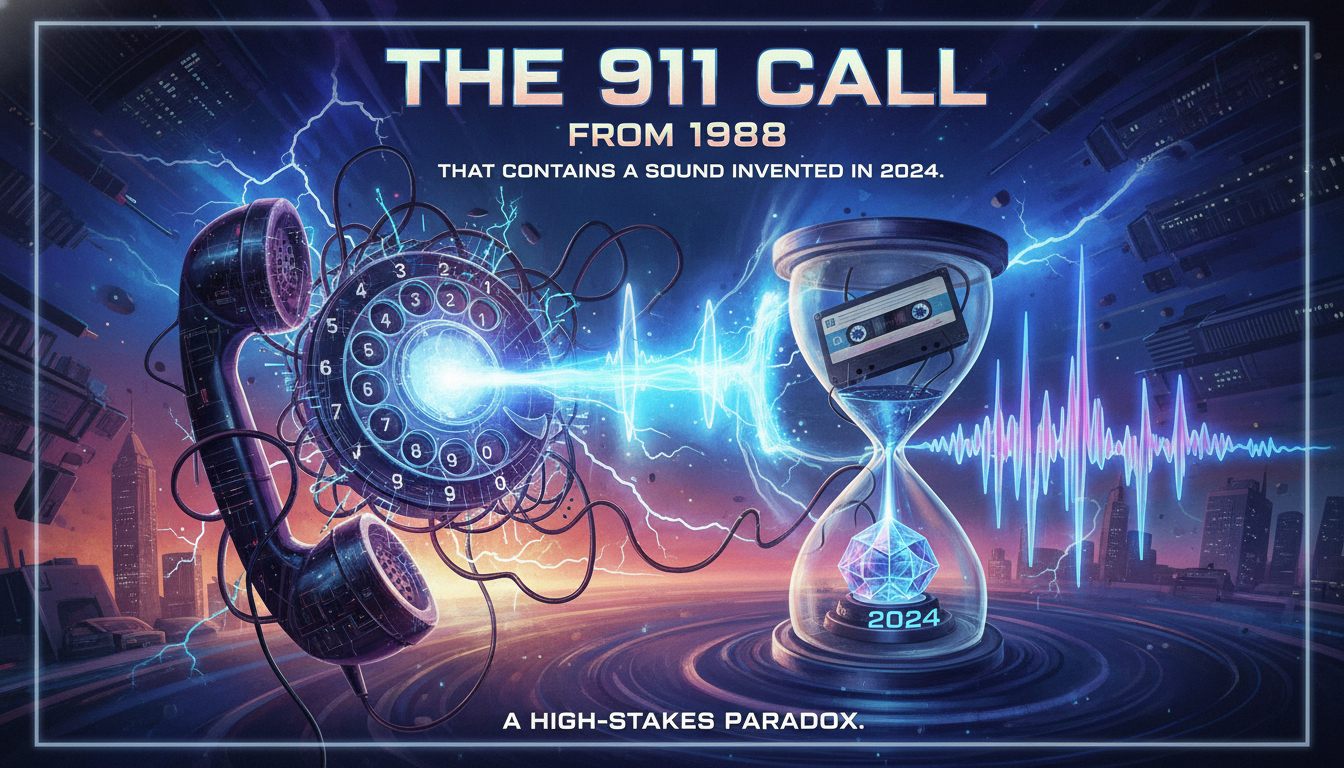
Elias Thorne’s right ear was dying. The audiologist called it progressive sensorineural hearing loss, but Elias knew it was a slow eviction. By Christmas, the world would be a pantomime. This was why he sat in a room lined with charcoal-colored acoustic foam, pressed his high-fidelity headphones against his skull, and listened to the dead.
The tape was labeled *Case 88-4092: Vance, Sarah.*
The recording was thirty-six years old. It was a magnetic ghost, a thin ribbon of polyester coated in chromium dioxide. On the tape, Sarah Vance was seven minutes away from having her throat opened with a serrated kitchen knife. She was hiding in a crawlspace in Orem, Utah, whispering into a heavy rotary-dial phone.
Elias adjusted the sliders on his mixing board. He filtered out the 60Hz hum of the eighties power grid. He shaved off the top-end hiss.
“I can hear him,” Sarah whispered. Her voice was a dry leaf skittering across pavement. “He’s in the kitchen. He’s opening the drawers.”
Elias watched the waveform on his monitor. It was a jagged mountain range of green light. He zoomed in on the silence between Sarah’s breaths. In that silence, there was a sound.
*Click-tack. Click-tack-tack.*
It was rhythmic. It was surgical. Elias frowned, his pulse thumping against the earcups of his headphones. He ran a spectral analysis. The sound was a burst of high-frequency data, a packet-switching handshake pulsing at exactly 2.4 gigahertz.
Elias stopped the playback. He felt a cold prickle at the base of his spine.
That specific frequency did not exist in 1988. The protocol for digital encryption—the kind used by modern-day Aethelgard quantum processors—wasn’t patented until three years ago.
He leaned closer to the screen. The clicking wasn’t background noise. It was a signature. It was the sound of a modern digital device “talking” to a network. In a house that had been burned to the ground decades before the internet was a household word.
He played the segment again, boosting the gain until his eardrum throbbed with a dull, bruised heat.
*Click-tack. Click-tack-tack.*
Underneath the digital handshake, he heard a second sound. It was the heavy, wet dragging of a boot. And then, a man’s voice. It was distorted, filtered through something that sounded like a voice-changer, but the cadence was unmistakable. It was the flat, bored tone of a technician.
“Signal’s clear,” the man on the 1988 tape said. “The harvest is ready.”
Elias pulled the headphones off. The silence of the room rushed in, thick and suffocating. He touched his ear. It was wet. He pulled his finger away and saw a smear of bright, arterial red. His ear wasn’t just failing; it was protesting.
He looked at the digital file on his screen. Sarah Vance had died in 1988. Her killer had never been found. The case was a pillar of local tragedy, a story used to frighten children into locking their windows.
Elias opened a private browser. He typed: *Aethelgard + 1988 + Beta Testing.*
Nothing.
He typed: *Aethelgard + Audio Forensic Signatures.*
He found a proprietary white paper buried on a server in Stockholm. It described “Temporal Acoustic Fingerprinting.” The paper was dated next month.
His stomach performed a slow, sickening roll. He felt like he had swallowed a handful of lead buckshot. He went back to the audio. He isolated the digital handshake and ran it through a decryption algorithm he’d “borrowed” from the NSA during a consultancy gig.
The computer hummed. The fans kicked on, whining like a panicked animal.
A text box appeared on the screen.
*DECRYPTION COMPLETE.*
*USER ID: THORN_E_092*
*TIMESTAMP: 11/14/2024*
*LOCATION: SECTOR 4 – HISTORICAL CALIBRATION*
Elias’s breath hitched. That was his name. His ID.
He looked at the date on the screen. It was today’s date.
He put the headphones back on. He had to. The need to know was a parasite, burrowing into his brain. He pressed play.
Sarah Vance was crying now. “He’s at the door. Please. Help me.”
“Hush, Sarah,” the technician’s voice said on the tape. “The data needs to be clean. We need to see how the fear affects the resonance.”
“Who are you?” Sarah sobbed.
“I’m the observer,” the voice replied. “And you are the baseline.”
Elias heard the sound of the crawlspace door being wrenched open. He heard the girl’s scream—a sharp, piercing frequency that spiked the levels into the red. It was a sound of pure, unadulterated terror, the kind that makes the muscles in the back of your neck lock until they ache.
And then, over the scream, the technician spoke again.
“Elias,” the voice said. “Stop listening.”
Elias froze. His hands hovered over the board.
“You’re making the feedback loop worse,” the voice continued, coming through the 1988 recording. “Every time you replay this, we have to go back and sharpen the blade again. You’re hurting her, Elias. Your observation is the catalyst.”
Elias felt a sudden, violent coldness in his chest. He looked at the waveform. It was changing in real-time. The green lines were morphing, growing sharper, jagged like teeth.
He reached for the power switch, but his hand wouldn’t move. He was staring at the spectral display. He saw a shape forming in the frequencies. It wasn’t a sound. It was a face.
It was his own face, rendered in neon green light, his mouth open in a silent, digital wail.
The clicking started again. *Click-tack. Click-tack-tack.*
It wasn’t coming from the headphones. It was coming from the acoustic foam behind him.
Elias turned around. The wall was vibrating. The charcoal foam was pulsing in time with the 1988 handshake.
A small, silver disc was embedded in the wall. It looked like a smoke detector, but the LED was a cold, piercing violet. It was an Aethelgard surveillance node. He’d had it installed three months ago as part of a “smart home” upgrade.
The node spoke. It used the technician’s voice.
“The experiment requires a witness who can truly hear,” the wall said. “That’s why we gave you the tinnitus, Elias. We needed to tune your ears to the right frequency. You didn’t think a healthy man’s hearing just… rotted, did you?”
Elias tried to scream, but his throat felt like it was filled with wet sand. He fell from his chair, his knees hitting the floor with a dull, sickening crack.
In his headphones, which had fallen to the rug, he could still hear Sarah Vance. She wasn’t screaming anymore. She was whispering.
“Is he gone, Elias? Is the man with the light gone?”
Elias looked at the violet LED on his wall. It flickered.
“Not yet, Sarah,” the technician’s voice whispered from every corner of the room. “He hasn’t finished the recording yet.”
Elias reached for the headphones, his fingers trembling, his vision blurring as the pressure in his skull reached a breaking point. He realized with a soul-crushing clarity that he wasn’t the analyst. He was the medium. The recording wasn’t from 1988.
The recording was happening right now. And it was happening thirty-six years ago.
He saw the shadow move across the foam. It wasn’t a man. It was a silhouette of static, a tear in the fabric of the room. It held something long and thin that glinted with the light of a thousand dead stars.
Elias Thorne’s right ear finally went silent.
The last thing he heard was the sound of a serrated knife entering a drawer, and the rhythmic, satisfied clicking of a machine that had finally found its signal.