

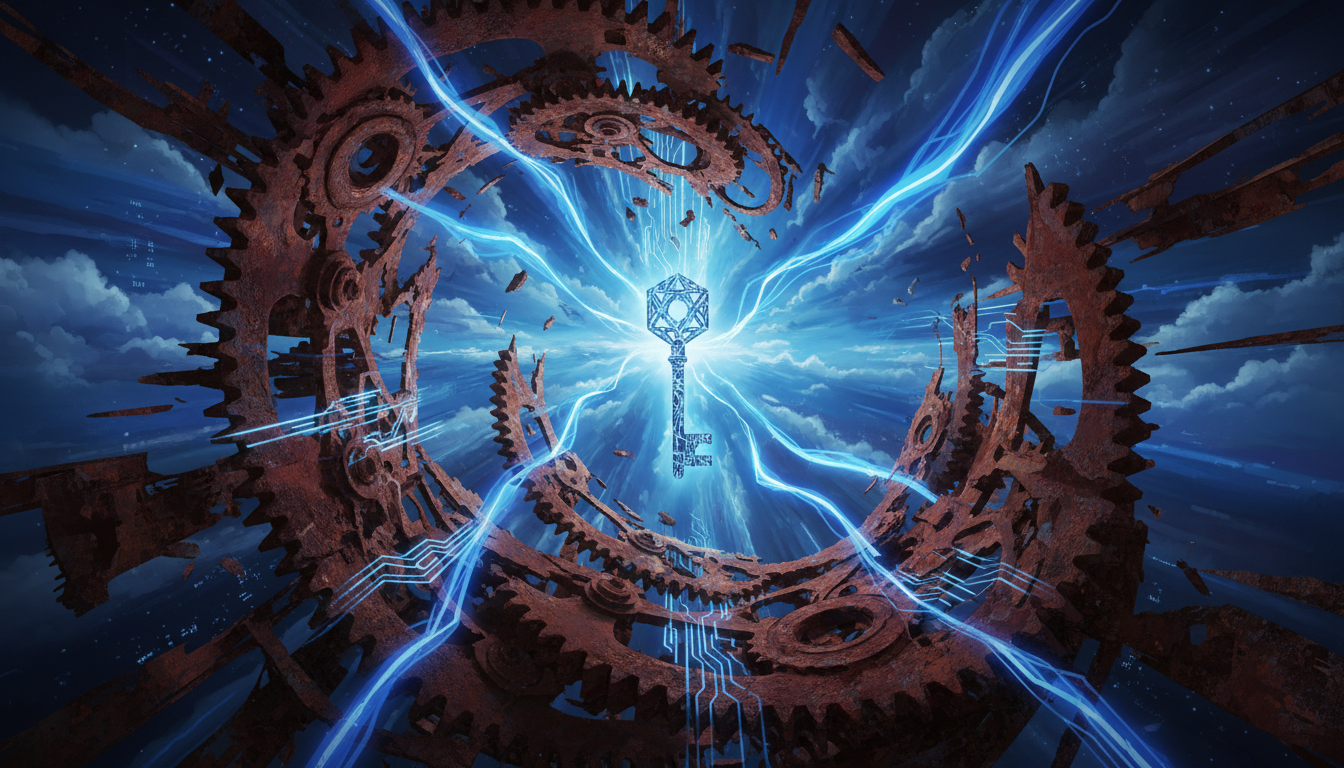
Mick hated the way his new lungs sounded. They didn’t breathe: they clicked. It was a rhythmic, metallic ticking that lived right behind his ribs, sounding like a cheap clock stuck in a jar of oil. Every time he took a deep breath, the gears shifted with a wet thud. It reminded him of his dad’s old 1984 pickup truck, the one that used to stall out at every stoplight in South Philly. He missed that truck. He missed the way the vinyl seats used to stick to the back of his legs in July. Now, he was forty thousand feet in the air, crouched in a vent that smelled like burnt wires and ozone, waiting for a world to end.
The agency had tossed him out like a crumpled soda can two years ago. They told him he was “too damaged to repair,” which was a funny way of saying they didn’t want to pay for his oil changes anymore. He was a used-up tool with a chest full of experimental junk. But now, the high-altitude station called The Needle was falling apart. If it hit the ground, a cloud of nasty green gas would wipe out half the coast. Mick was the only one with the code to stop the timer. He wasn’t here to be a hero: he was here because he wanted to feel the sun on his face one more time without it being filtered through a thick sheet of plastic.
The station groaned. It was a deep, belly-aching sound that vibrated through Mick’s knees. The whole place was tilting. He crawled faster, his mechanical lungs whirring like a vacuum cleaner. He remembered a girl named Della. She used to wear a perfume that smelled like lemons and old books. They used to sit on his roof and watch the planes go by. He wondered if she was still down there, maybe looking up at the sky right now, unaware that a giant metal coffin was about to drop on her head. The thought made his chest feel tight, a sudden coldness that had nothing to do with the thin air.
He kicked the vent cover open. It fell into a hallway that was currently standing at a thirty-degree angle. Mick tumbled out, his boots skidding on the slick white floor. The station gave a violent jerk. A piece of the ceiling snapped off and crashed three inches from his head. He scrambled up, his heart hammering against the metal plates in his chest. Everything was screaming. Alarms blared in a high, piercing tone that made his teeth ache. It was a messy, loud kind of chaos, nothing like the clean, quiet movies.
“Come on, you piece of junk,” Mick hissed at himself.
He reached the main computer room. It was a glass box hanging over the clouds. Outside, the sky was a deep, bruising purple. The station was shedding parts. Huge chunks of metal were peeling off and falling into the dark. It looked like a giant bird losing its feathers. Mick shoved his hand into the port. His fingers were shaking. He felt the encryption key vibrate under his skin. This was the only part of him that still worked perfectly, a gift from the people who had ruined his life.
The screen flickered. A countdown was pulsing in bright, angry red. *00:42*. *00:41*.
Mick closed his eyes for a second. He didn’t see the computer. He saw the corner store back home. He saw the way the neon sign for “Cold Beer” used to buzz and flicker. He could almost smell the salt on the pretzels. He missed the dirt. He missed the way things used to be simple before he agreed to let them “upgrade” him. He was a man made of scrap metal, trying to save a world that didn’t even know his name.
He punched in the final sequence. His lungs stalled for a heartbeat, then kicked back in with a loud *clack-whir*.
The timer stopped at three seconds.
The station gave one last, tired shudder. The red lights turned to a soft, calm blue. Mick leaned his head against the cold glass. He was covered in sweat and grease, and his ribs hurt where the lung-pump was rubbing against his bone. He watched a piece of the outer hull drift away into the clouds. It looked like a falling star.
He knew he had to move. He had to find an escape pod before the whole thing snapped in half. But for a minute, he just sat there. He thought about Della. He thought about that old truck. He thought about how the air used to taste back when he could breathe it on his own. He was tired of being a machine. He just wanted to go home and sit on a porch until the sun went down.
The station tilted further, and Mick started to climb. He moved like a man who had somewhere to be, his mechanical chest ticking away the seconds, a lonely little clock in a dying sky.