
Mick used to be a King of Steel. That was back in the Quiet Times, the years before the ground decided it did not want to hold us up anymore. In those days, a man could build a tower and expect it to stay where he put it. Mick was the best of the Bone-Keepers. That is what we called the engineers who knew the secrets of the sky. He had hands that could feel a fraction of an inch of sway, and a heart that beat in time with the hammers. But that was a lifetime ago, before the Spire broke him.
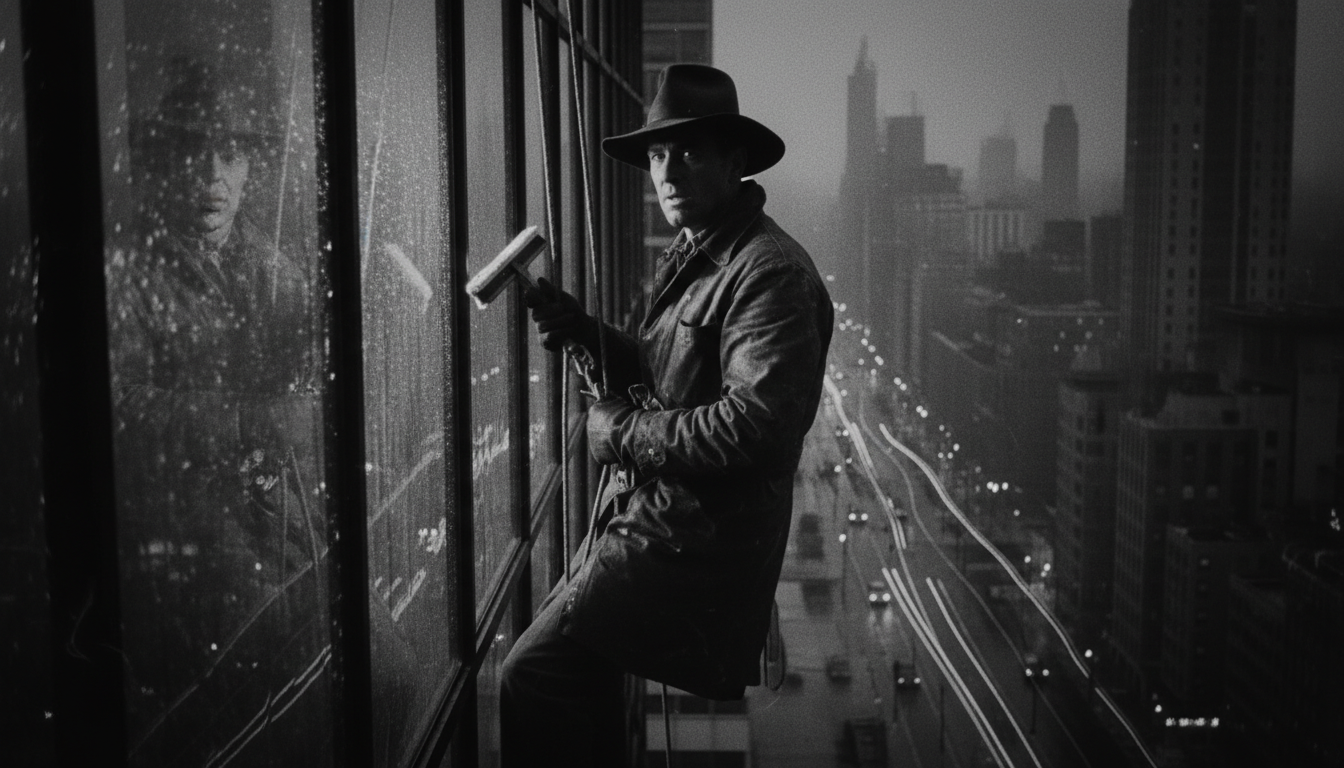
He was hanging by a couple of nylon ropes and a prayer when the Big One finally hit. Mick was sixty floors up, scrubbing the grime off the windows of the very building that had cost him his throne. It was funny, in a way that makes you want to spit blood. He had warned them that the Spire was built on a lie. He told Knox, the lead architect, that the steel was thin and the joints were weak. Knox just laughed and fired him. Then Knox made sure Mick never worked in an office again. So, Mick took the only job left. He washed the windows of his own mistake.
The first shake felt like a giant took the building and gave it a good kick. Mick’s bucket of soapy water tipped over, drenching his boots. He looked down through the glass. He saw the city of his youth, a place that used to smell like fresh rain and hot dogs, now turning into a cloud of gray dust. The Spire groaned. It was a deep, sick sound. It sounded like a dry bone snapping inside a leg. Mick knew that sound. He knew the Spire had exactly sixty minutes before it folded like a cheap card table.
He didn’t think about running. There was nowhere to run. Instead, he thought about the little black box in Knox’s penthouse office on the eightieth floor. That box held the digital keys. It held the proof that Knox had bought cheap steel and pocketed the rest of the cash. If Mick was going to die, he wanted to die holding the truth. He wanted the world to know he wasn’t the crazy one. He wanted his name back.
His knees made a sound like a bag of dry cereal being crushed as he stood up on the narrow ledge. He was sixty-two years old, and his body was a map of old injuries. But he had his suction cups and his grip. He looked at his watch. Fifty-eight minutes left.
“Come on, you old dog,” Mick whispered. His voice was scratchy, like sandpaper on wood.
The wind up there was a mean thing. It whipped around the corners of the glass, trying to peel him off like a scab. Mick slapped a suction cup onto the pane. *Thwack.* Then the next one. *Thwack.* He began to climb. It was slow work. Every time the earth shook again, the building swayed five feet to the left. Mick would hold on, his face pressed against the cold glass, watching the ghosts of his old life flicker in the reflection.
He remembered when he and Sarah used to walk these streets. They would go to the park on 4th Street and eat ice cream until their teeth ached. Sarah loved the way the city looked at night. She said the lights looked like fallen stars. Now, the lights were flicking out, one by one. The park was probably gone. The ice cream shop was a memory. A deep, soulful ache settled in his chest, heavier than the wind. He wasn’t just climbing a building. He was climbing a tombstone.
At the seventieth floor, a window above him blew out. Shards of glass rained down like jagged diamonds. One sliced his cheek, and the blood felt hot against the cold wind. Mick didn’t flinch. He couldn’t afford to. He reached up, his fingers cramping into tight knots. He thought about the dust on the redundant second chair in his old office. He used to keep it there for Sarah to sit on when she brought him lunch. It had been empty for five years. He wondered if the dust was still there, or if the shaking had finally blown it away.
“You’re doing great, Mick,” he lied to himself.
The Spire gave a violent lurch. Mick’s left suction cup lost its grip. He swung out into the empty air, suspended by a single hand and a thin safety line. For a second, he just watched his boots dangle over the edge of the world. He saw a car crushed by a falling brick a thousand feet below. It looked like a toy. He felt a sudden coldness in his stomach, the kind you get when you realize you are completely alone.
He kicked his feet, searching for a grip. His toes found a decorative ledge. He hauled himself back against the glass, his breath coming in ragged gasps. He looked at his watch. Twenty minutes.
The penthouse was close now. He could see the gold trim on the windows. It was the kind of gold that looked pretty but hid a rotten core. Mick reached the balcony and pulled himself over the railing. He collapsed on the plush carpet, his lungs burning. The room was beautiful. It was full of paintings and statues that cost more than Mick had made in ten years. It felt like a slap in the face.
He found the desk. It was a heavy piece of oak that looked like it belonged in a castle. He scrambled behind it, his fingers fumbling with the drawers. He found the black box. It was small, heavy, and cold. He tucked it into his vest pocket, right against his heart.
The building screamed. It was a loud, metallic shriek that vibrated through his teeth. The floor tilted at a sharp angle. Books slid off the shelves. A glass of expensive scotch shattered on the floor, the smell of peat and smoke filling the air. It reminded him of his father. His father had been a carpenter, a man who believed that if you built something, you built it to last forever.
“Sorry, Pop,” Mick muttered. “I tried.”
He had ten minutes. He could try to get to the roof and hope for a helicopter, but the sky was choked with smoke. He looked at the window. He looked at the city he had helped create, now breaking into pieces. A weird sense of calm came over him. He wasn’t scared anymore. He was just tired. He was nostalgic for a world that didn’t shake.
He sat down in Knox’s big leather chair. It was soft. It felt like a cloud. He pulled a small, crumpled photo from his wallet. It was Sarah at the beach. She was laughing, her hair blowing across her face. He remembered the smell of the salt air and the way the sand felt between his toes. That was a good day. It was a day when the ground stayed still.
The Spire groaned one last time. It was a final, weary sound. Mick felt the floor drop. It wasn’t a fast fall at first. It was a slow, heavy tilt. He closed his eyes and held the black box tight. He thought about the ice cream on 4th Street. He thought about the blue-prints he used to draw with a steady hand.
He felt the wind rush past the windows. He felt the weight of the building give up its fight with gravity.
In the stories we tell now, they say the Glass King didn’t fall. They say he flew. But the truth is simpler. Mick just wanted to be right one last time. When they found him in the rubble three days later, his hand was locked around that black box. His face was calm. He looked like a man who had finally found a place where nothing ever shakes.
We keep his watch in the museum now. It stopped at exactly 4:12 PM. The glass is cracked, and the leather strap is worn thin. But if you hold it close to your ear, you can almost hear the heartbeat of a man who knew that the only thing stronger than steel is the truth. It makes you miss the days when buildings stood tall and men like Mick were the ones who kept them that way. It’s a sad kind of memory, the kind that sticks in your throat like dust. But it’s all we have left of the city before the Big Shakes took the rest.