
The gates of the Blackwood Estate did not swing open: they shrieked. Mona pulled her coat tighter against a wind that smelled like wet earth and old copper. She needed this job. Her firm was one week away from bankruptcy, and her name was mud in every city from here to the coast. This restoration was her last chance to prove she wasn’t the architect who let a library collapse in Chicago.
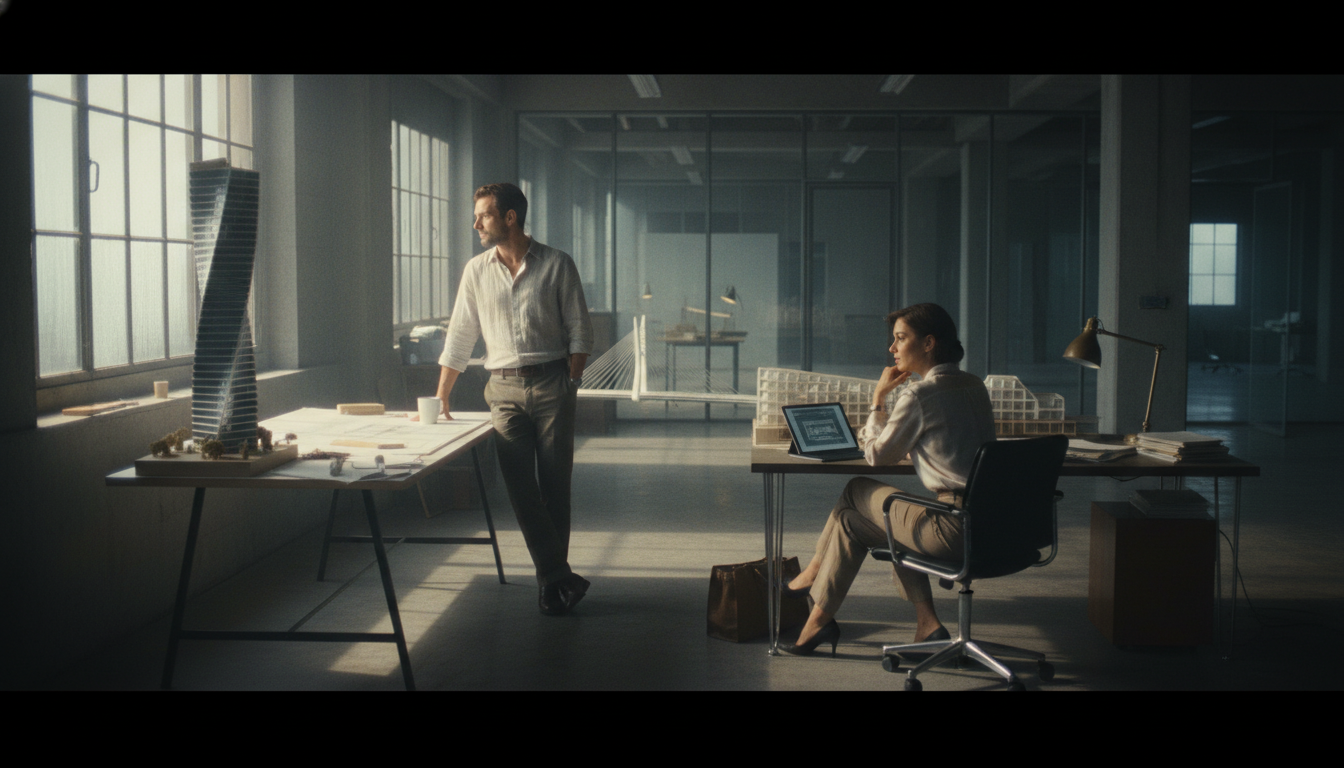
She saw him standing on the porch. Hayes. He looked like a man made of shadows and sharp angles. Three years ago, he was the golden boy of the industry. Then he went into a house in the woods to build a masterpiece and came out six months later with white hair and a broken mind. He hadn’t touched a drafting table since. Now, the owners had forced them together. A disgraced genius and a desperate failure: the perfect pair to fix a house that looked like it wanted to swallow the sky.
“Don’t go inside after the light hits the floorboards,” Hayes said. His voice was like dry leaves scraping on stone. He didn’t look at her. He looked at the front door, which sat slightly crooked in its frame.
“I have a deadline, Hayes,” Mona said. She tried to sound brave. “The competition judges will be here in a month. We don’t have time to be afraid of shadows.”
“It isn’t the shadows you should worry about,” Hayes whispered. He finally looked at her. His eyes were bloodshot and wide. “It is the way the house moves when you are looking right at it.”
They spent the first week in a cold silence. Mona mapped the floor plans. Hayes sat in the corner of the grand hall, drawing circles on pieces of scrap paper. Every time Mona measured a room, the numbers were different. One day the hallway was forty feet long. The next day, it was thirty two. She told herself her tape measure was slipping. She told herself the damp air was warping the wood.
The first time she felt the true cold was in the kitchen. She was sketching the pantry when the door clicked shut. There was no wind. The latch didn’t just fall: it turned. She grabbed the handle, but it felt like ice. It burned her palm.
“Hayes!” she yelled.
Silence. Then, a soft, wet sound from the corner of the ceiling. Something was dripping, but there were no pipes in the walls here. She looked up. The plaster was pulsing. It looked like a throat trying to swallow.
The door flew open. Hayes grabbed her arm and yanked her into the hall. His grip was frantic. He pulled her all the way to the porch before he let go. They stood in the grey afternoon light, both of them shaking.
“I saw it,” she breathed. Her heart felt like a bird trapped in a box. “The wall. It moved.”
“It’s hungry,” Hayes said. He slumped against a stone pillar. “I didn’t lose my mind three years ago, Mona. My partner did. She’s still in the walls of the last place we built. This house… it’s the same architect. It’s the same bones.”
Mona looked at his hands. They were scarred with deep, jagged lines. He hadn’t been drawing circles. He had been drawing a map of the house’s veins.
“We have to finish,” Mona said. Her voice broke. “If I walk away, I’m dead anyway. I have nothing left.”
“I know,” Hayes said. He stepped closer. For a second, the professional wall between them vanished. He reached out and touched her cheek. His skin was warm, the only warm thing in this entire valley. “I stayed because I didn’t want you to be alone when it started to happen.”
The romance between them was a desperate thing. It wasn’t built on dinners or soft music. It was built on the way they huddled together in a single sleeping bag on the porch, too afraid to sleep in the bedrooms. It was the way Hayes held her hand while she climbed the attic stairs. It was the smell of his wool sweater and the way he whispered her name when the house started to groan at 3:00 AM.
They were two broken people clinging to each other while a monster made of brick and mortar tried to pull them apart.
By the third week, the house began to change faster. The stairs didn’t lead to the second floor anymore. They led to a basement that wasn’t on the maps. The windows showed a forest that didn’t exist outside.
“We have to design a way out,” Mona said. They were trapped in the library. The door had disappeared an hour ago. In its place was a solid wall of oak. “Not a door. The house knows what doors are. We have to build something it doesn’t recognize.”
Hayes looked at her. The fear in his eyes was being replaced by a frantic kind of love. “A window,” he said. “But not in the wall. In the floor.”
They worked by candlelight. Mona drew the shapes. Hayes calculated the weight. The house didn’t like it. The floorboards beneath them began to curl like scorched paper. The air grew thick and tasted like old blood.
“It’s coming for us,” Hayes said. He grabbed a crowbar. “Mona, look at me.”
She looked.
“If we get out,” he said, “we never look back. We leave the names, the money, the career. We just run.”
“Yes,” she sobbed. “Anything. Just get me out of here.”
He kissed her then. It was a hard, tasting kiss that felt like a goodbye and a promise all at once. Then he slammed the crowbar into the floor.
The house roared. It was a sound of grinding stone and snapping glass. The library began to tilt. Books flew off the shelves like birds. Mona screamed as a floorboard snapped and caught her ankle. It didn’t just break the bone: it wrapped around her like a tentacle.
“Hayes!”
He didn’t run. He threw himself onto the floor and clawed at the wood with his bare fingernails. He bit the wood. He hammered at it until his knuckles were white bone. The house was screaming now, a high-pitched whistle that made Mona’s ears bleed.
With a final, sickening crack, the floor gave way. They didn’t fall into a basement. They fell into the cold, wet grass of the front yard.
Mona lay on her back, gasping for air. The moon was high and indifferent. She looked at the house. It stood perfectly still. The windows were dark. The door was right where it should be. It looked like a normal, beautiful, expensive Victorian home.
Hayes was beside her, his chest heaving. His hands were a red mess. He crawled over to her and pulled her head into his lap.
“We’re out,” he whispered. “We’re out.”
But as Mona looked up at the master bedroom window, she saw a light flicker. It wasn’t a candle. It was the reflection of a girl standing inside, her hands pressed against the glass. The girl looked exactly like Mona.
Mona closed her eyes and pressed her face into Hayes’s chest. She could feel his heart beating. It was fast and terrified.
They drove away that night. They left their tools, their cars, and their dreams. They moved to a small town where the houses were made of tin and plastic. They never lived in a building with a second floor again.
But sometimes, when it rains, Mona wakes up and feels the bed underneath her pulse. She feels the walls of their small trailer lean in just a little bit. She looks at Hayes, and she knows he feels it too.
The house didn’t let them go. It just gave them a longer leash. Whenever she sees a beautiful building now, she doesn’t see art. She sees a mouth, waiting for someone to walk inside and try to fix it.