

I saw Leo at the Ritz: he was a total wreck. You remember Leo, right? The man who won all those awards for tearing down mayors and exposing the big cats. Ten years ago, he was the king of the newsroom. Now, he looked like he slept in a dumpster. His tie was stained with what looked like cheap mustard. Everyone was whispering behind their silk fans. It was the best kind of drama. But then he looked at me: and his eyes were empty. Not just “I’ve had too many martinis” empty. They were “I don’t know where I am” empty.
That was the scandal of the season. Leo, the great hunter of truth, was losing his mind. People called it early-onset. I call it a tragedy with a side of irony. He was always so sharp: now he was as dull as a rusted butter knife. He was clutching a shoebox tied with kitchen string like it was a pile of gold.
I followed him. Don’t judge me: I’m a gossip. It’s my job to know why a man in a three thousand dollar suit is hiding under a dessert table. He was muttering about “Sterling Chemicals.” He was whispering about water and lead and a man named Artie. My curiosity was on fire. Was he crazy: or was he still the best reporter in the city?
He slipped out the back door and I followed him to a diner that smelled like old grease and regret. He sat in a corner booth with a girl. I knew her: that was Sia. His daughter. She hadn’t spoken to him since she was twelve. She looked like she wanted to be anywhere else. She was wearing a nurse’s outfit: tired and angry.
“I don’t have time for this, Leo,” she said. She didn’t even call him Dad.
Leo opened the shoebox. It wasn’t gold. It was a mess of sticky notes. Hundreds of them. Blue, yellow, pink. They were stuck to napkins and old receipts. He started shaking. His hands were like leaves in a storm.
“The water, Sia,” he whispered. “The kids in the north district. Sterling knew. They buried the report in eighty-nine. I found the guy: Artie. He’s scared. I need you to… to help me.”
He stopped. He looked at his hands. A look of pure terror crossed his face.
“Who are you again?” he asked.
Sia flinched like he’d hit her. That was the deep wound: right there in the open. He didn’t even know his own heart. She started to get up, her eyes stinging. But then she looked at the notes. She saw the names. She saw the dates. She saw a picture of herself as a little girl clipped to a document that looked very, very official.
I sat in the booth behind them, sipping terrible coffee. I wanted to see the car crash, but I stayed for the miracle.
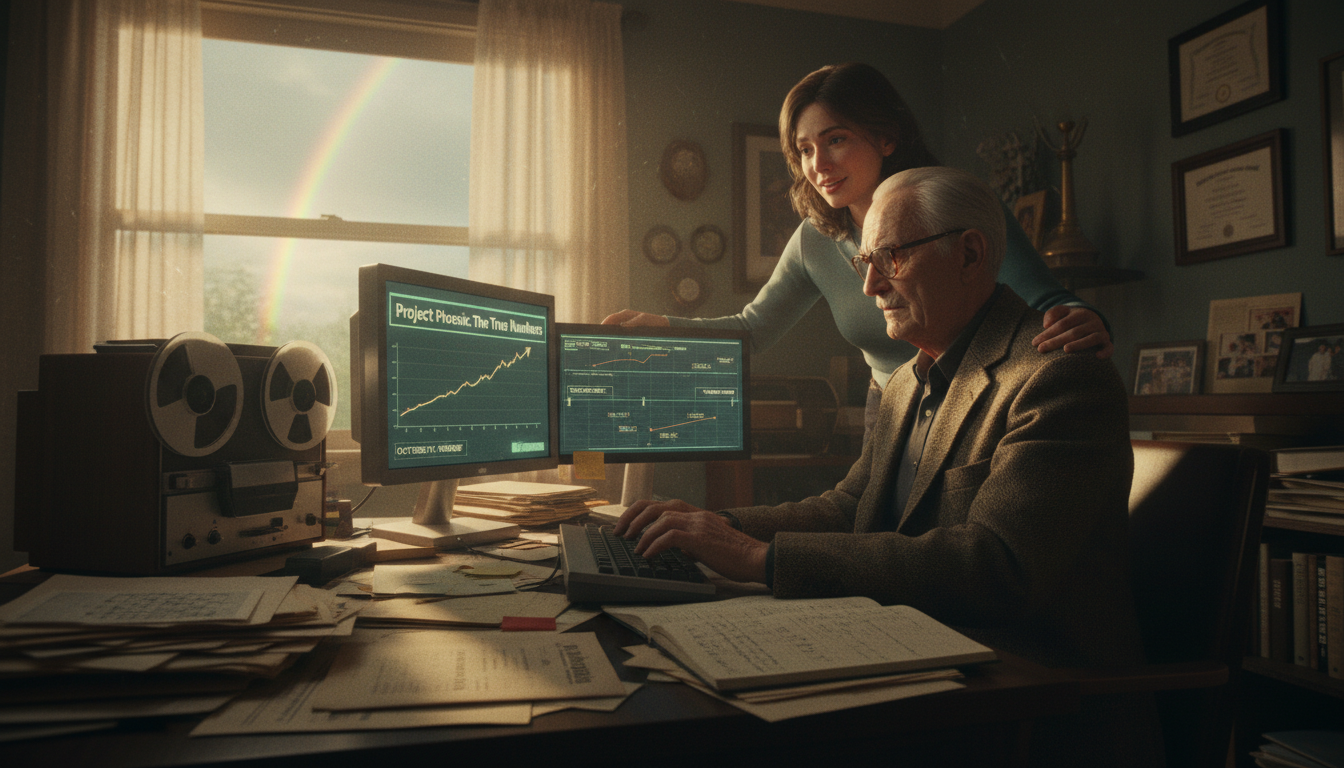
For the next three weeks, I watched them. I have my ways. I saw them in the library. I saw them at the park. Leo was fading fast. Some days he thought it was 1995. He would talk about his old boss like he was still alive. But Sia was there. She became his brain. She took those messy sticky notes and turned them into a map.
She was angry at first. She hated him for leaving her and her mother to chase stories. But as she read his notes, she saw the truth. He wasn’t just chasing fame. He was trying to save people. He just didn’t know how to save his own family at the same time.
The big gala for Sterling Chemicals was the finish line. It was a fancy “Green Earth” party. Everyone was there: Pearl, Trudy, even that snake Seth who runs the board. They were all smiling and drinking bubbles while the people in the north district were getting sick from their runoff.
Leo showed up. He looked better. Sia had bought him a new suit. She held his arm so tight her knuckles were white. He looked confused by the lights. I could see his lips moving. He was practicing. He was fighting the fog in his head with everything he had left.
“You can do this,” Sia whispered to him. “Just read what we wrote.”
They walked right up to the stage. Seth tried to stop them, but Sia looked him in the eye. She has her father’s fire. She pushed a USB drive into the hands of the guy running the big screen.
Leo stood at the microphone. The room went dead silent. He looked out at the crowd of rich, beautiful people. He looked lost. He looked like he was going to cry. He opened his mouth, but no words came out.
I felt a coldness in my chest. I thought he was going to fail. I thought the fog had finally won.
Then Sia stepped up. She didn’t take the mic. She just put her hand on his back. She stood there like a pillar.
Leo’s eyes cleared for one perfect second. He didn’t look at the crowd. He looked at her. He smiled. It was the most beautiful thing I’ve ever seen.
“My name is Leo,” he said. His voice was loud. It was the voice that used to make governors tremble. “And I have the receipts.”
The screen behind him exploded with images. Internal memos. Photos of rusted pipes. Documents signed by Seth himself. It was a bloodbath of truth. The “Green Earth” party turned into a crime scene in ten minutes. The reporters who were there for the party started scribbling. The police were called.
Leo didn’t stay to see the arrest. He didn’t stay for the applause. He walked off that stage with Sia.
I followed them out to the sidewalk. The cool night air felt different. It felt clean.
Leo was sitting on a stone bench. He was looking at his shoes.
“That was a good party,” he said. He looked at Sia. “Do I know you, miss? You have very kind eyes.”
Sia didn’t cry. Not this time. She just sat next to him and took his hand.
“I’m Sia,” she said. “I’m your daughter.”
“Sia,” he repeated. He liked the sound of it. “That’s a pretty name. Did I ever tell you about the time I broke the Sterling case?”
“Tell me again,” she said.
They sat there in the dark: a disgraced hero and the daughter who brought him home. It wasn’t a movie ending. There were no big speeches left. But as I watched them walk away: Leo leaning on her, Sia guiding him toward a car: I knew I had just seen the biggest story of my life.
The gossip columns would talk about the scandal of Sterling Chemicals for years. They would talk about the money and the jail time. But I would only remember the way Leo looked at his daughter when he forgot everything else. It was a win. A quiet, beautiful win.
I went home and threw away my notes on the Ritz. Some stories are too good to sell. Some stories are just for the heart. Leo was gone: the man he used to be was a ghost. But in those final moments, he wasn’t a journalist. He was a father. And for a man like Leo: that was the greatest scoop he ever got.