

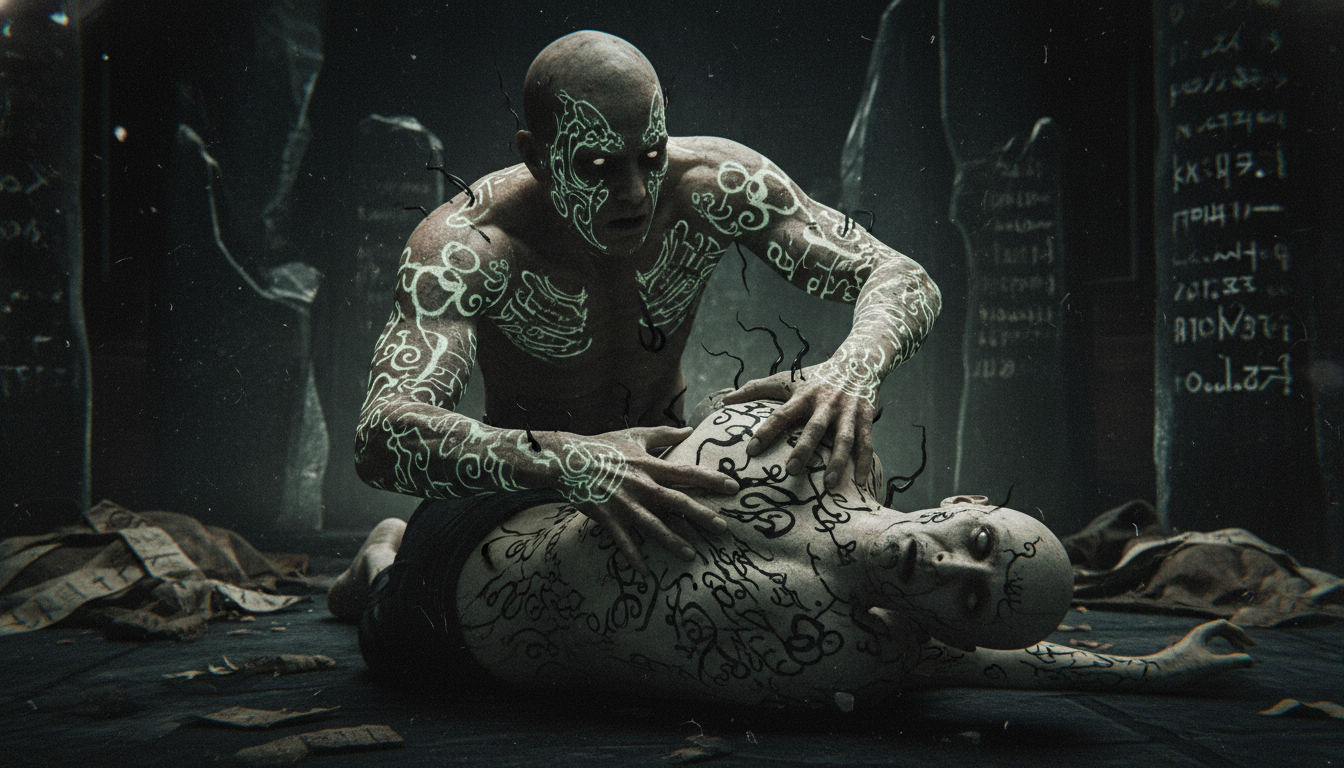
Silas knew the value of a man by the ink on his skin. To some, a tattoo was just a mark of a drunk night or a lost bet. To Silas, it was a ledger. He was an ink-mage, once a high clerk in the marble halls of the capital. Now, he lived in the muddy streets of the rim towns. He was an exile. His crime was simple: he told the truth with a pen. He had written down the names of the people the King had starved, and for that, the King took his pens away. He cursed Silas so he could only move ink that was already trapped in living flesh.
Every morning, Silas felt the itch in his fingers. It was a dull ache, like a tooth that needed pulling. He sat in a tavern called The Broken Keg and watched the trades come and go. He saw Victor, a dockworker with a ship tattooed on his chest. Silas could make that ship sail across Victor’s ribs with a flick of his mind, but there was no profit in it. Silas lived by the trade. He moved the ink for a loaf of bread or a warm place to sleep. He was a merchant of memories, and his own memory was a heavy bag of rocks he carried everywhere.
One Tuesday, a man named Reid walked into the tavern. Reid was a royal scout, and he looked like he had been kicked through a bramble patch. He sat next to Silas and didn’t buy a drink. Instead, he pulled out a heavy lead box.
I have a job for a man who knows how to handle letters, Reid said. His voice was like grinding stones.
Silas looked at the box. I don’t work for the crown anymore. The pay is bad, and the bosses are worse.
This isn’t for the King, Reid whispered. This is for everyone. A scroll got loose. A sentient one. It was part of the Great Archive. It’s a runaway spell, Silas. It has started eating the history books. It’s moving through the villages and rewriting the past. If it eats the foundation of the throne, the whole kingdom falls into chaos. There will be no laws. No records. Just a blank slate.
Silas felt a spark in his gut. A blank slate sounded like a dream. But he knew the cost of chaos. Chaos meant the strong ate the weak. He thought about the orphans in the streets. If the records of their parents died, they would be truly alone.
What’s the trade? Silas asked.
The King will lift your exile, Reid said. You can have your pens back. You can go home.
Silas looked at his hands. They were stained with the cheap, blue ink of the poor. He missed the smell of high-grade vellum. He missed the quiet of the library. He agreed.
They tracked the scroll for three days. They found it in a small village called Oakhaven. The village was quiet. Too quiet. Silas saw a woman named Jade sitting on her porch. She was staring at her hands.
Jade was a weaver. Everyone knew her family had been weavers for ten generations. But as Silas watched, the ink on her forearm began to smoke. A tiny, glowing piece of paper was hovering near her skin. It was the scroll. It looked like a long, thin snake made of yellowed parchment. It was sucking the ink right out of her skin.
Stop! Silas shouted.
He reached out with his mind. He felt the ink in Jade’s arm. It was cold. It felt like old, frozen grease. Usually, ink was warm. It lived with the person. But the scroll was turning the ink into nothing. It was erasing Jade’s history. It was eating the fact that her father had taught her to loom.
The scroll hissed. It didn’t have a mouth, but the sound came from the rustling of its paper body. It flew at Silas. It tried to wrap around his wrist, aiming for the small tattoo of a quill he had on his thumb.
Silas didn’t pull away. He grabbed the scroll with his hand. He felt the magic humming through it. It was a strange, hungry power. It wasn’t just erasing the King. It was erasing everything. It wanted to turn the world into a clean, white room where nothing ever happened.
I see you, Silas muttered.
He used his magic to pull the ink from his own thumb. He pushed the black liquid into the scroll. He didn’t try to kill it. He tried to write on it. He forced the ink to form words on the sentient parchment. He wrote about the taste of an apple. He wrote about the way his mother’s voice sounded. He wrote about the weight of a gold coin and the smell of the rain.
The scroll bucked and twisted. It was used to eating. It wasn’t used to being filled. Silas poured every memory he had into the paper. He gave it his exile. He gave it his loneliness. He gave it the image of the marble halls he missed so much.
The paper began to turn a deep, dark black. It grew heavy. It fell to the dirt, flapping like a dying bird. It couldn’t move anymore. It was too full of truth.
Reid ran forward with the lead box. He slammed the lid shut on the scroll.
You did it, Reid said, panting. We go back to the capital now. You’re a free man, Silas.
Silas looked at Jade. She was still looking at her arm. The tattoo was gone. She looked confused.
Who are you? Jade asked.
I’m nobody, Silas said.
He looked at Reid. The scout was smiling. He was thinking about the reward. He was thinking about the King’s favor. But Silas was thinking about the scroll inside the box. He realized that if he took it back, the King would just use it. The King would make the scroll eat the names of the rebels. He would make it eat the debts of the rich. The cycle would never end.
Silas felt a sudden, light feeling in his chest. It wasn’t the heavy ache of the merchant. It was something new. It was a sense of rightness.
Give me the box, Silas said.
Reid blinked. What? No. This belongs to the palace.
Silas didn’t use a weapon. He just looked at the ink on Reid’s neck. Reid had a tattoo of the royal seal. Silas reached out his hand and squeezed the air. The ink on Reid’s neck tightened. It felt like a ghost was choking him.
Drop it, Silas said quietly.
Reid dropped the box. He fell to his knees, gasping for air. Silas picked up the lead container. He walked to the village well and tossed it in. He heard it hit the water with a heavy splash. It would sink into the deep mud. The stories inside it, the ones Silas had written, would stay there forever.
What have you done? Reid wheezed. You threw away your life. You’ll never go home. You’ll never have your pens. You have nothing.
Silas looked at his hands. They were still stained blue. He looked at Jade, who was now talking to a neighbor. She looked happy. She didn’t have the weight of her ancestors on her arm anymore. She could be whatever she wanted to be today.
I didn’t throw it away, Silas said. I traded it.
For what? Reid asked.
For a better story, Silas replied.
He walked out of Oakhaven. He didn’t have a horse. He didn’t have gold. He didn’t have a home. But as he walked down the dusty road, he felt a strange, bubbling joy. It was the kind of happy that made you want to whistle even when your shoes had holes. He realized that he didn’t need the King’s pens. He had the ink of the whole world. He could help people change their own stories, one drop at a time.
He found a piece of charcoal by the side of the road and drew a small, smiling face on a rock. He left it there for the next person to find. It was a small trade, a bit of effort for a bit of wonder.
Silas kept walking. The sun felt warm on his back. For the first time in his life, his ledger was empty. He was starting a new page, and he was the one who got to choose the words. He started to hum a tune he hadn’t thought of in years. It was a simple song about a bird that flew over a wall and never looked back.
He was Silas the ink-mage, and he was finally, truly, wealthy.