

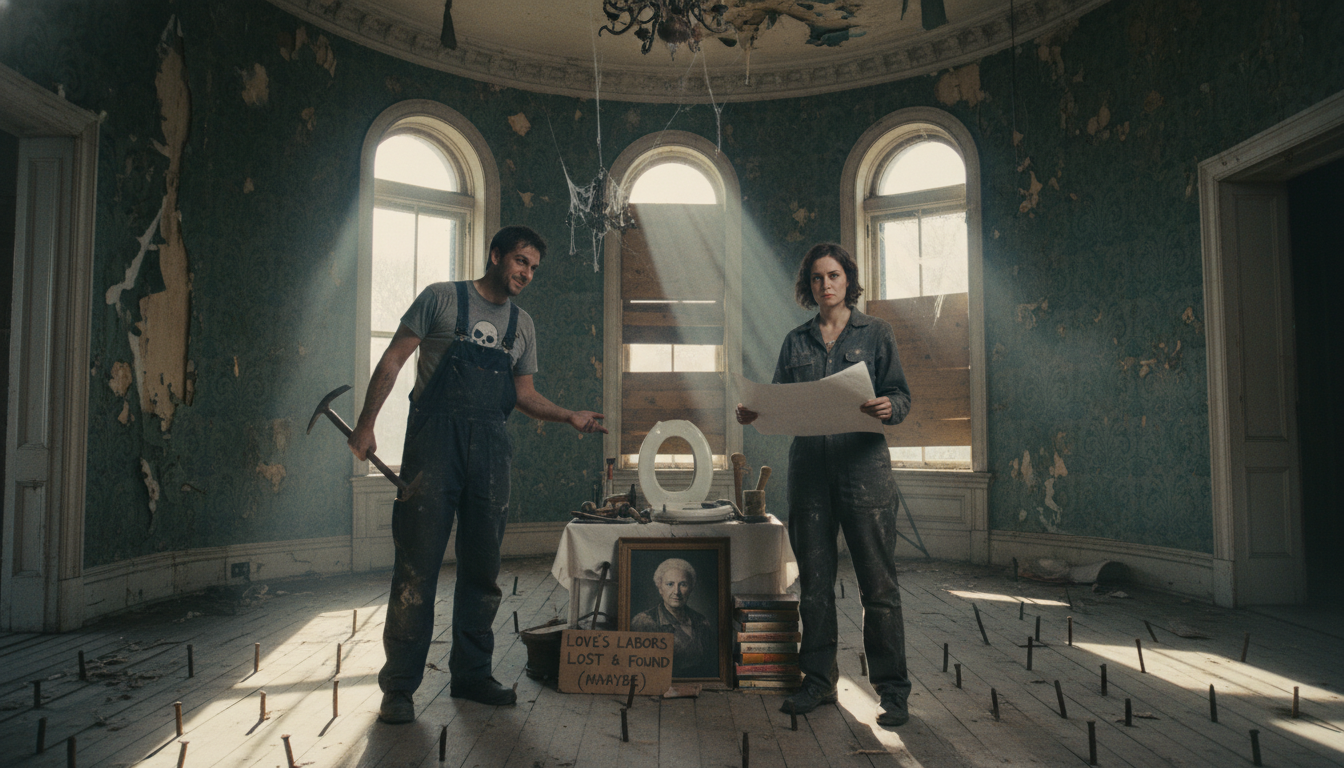
The front door of Blackwood Manor did not just close. It latched with the heavy, final thud of a coffin lid. Sloane stood in the foyer and felt the vibration in the soles of her boots. She checked the hinges: heavy brass, coated in a century of grime. They should have creaked. Instead, they moved with a silent, oily precision that made the hair on her arms stand up.
She was here to fix the bones of this place. As an architect, she saw the world in loads and levers. Everything had a breaking point. Her own career was currently sitting at that point. After the collapse of the downtown library project, she needed this renovation to prove she wasn’t a liability.
“The moisture levels are at forty percent,” a voice rasped from the shadows of the grand staircase.
Sloane didn’t jump. She just tightened her grip on her laser measurer. Zane stepped into the weak grey light filtering through the stained glass. He looked like a man who had spent too much time breathing in lead paint and secrets. Once, he had been the best historical preservationist in the state. Then he started claiming that old houses had “circulatory systems” and “memory.” Now, he was the only person desperate enough to work with Sloane.
“Zane,” she said. Her voice was flat, a steel ruler. “I see you haven’t found a barber since the scandal.”
“And I see you’re still trying to measure your way out of a hole,” Zane replied. He walked toward her. His boots didn’t make a sound on the warped oak floor. “This house doesn’t care about your blueprints, Sloane. It’s got its own ideas about where the walls go.”
Sloane ignored the chill in her chest. “It’s a structure, Zane. It follows the laws of gravity and physics. If a beam is rotting, we replace it. If the foundation is sinking, we jack it up. There is no magic here. Just bad maintenance.”
She walked past him to the center of the room. The air felt thick, like she was walking through invisible cobwebs. She looked up at the ceiling. The plaster was cracked in a pattern that looked like a map of a human nervous system.
“The client wants the master bedroom finished first,” Sloane said. “They have some superstitious idea about the house fixing their marriage. We have three weeks.”
Zane laughed. It was a dry, hacking sound. “The house doesn’t fix marriages. It knits people together. It stitches them into the grain of the wood until they can’t tell where their skin ends and the wallpaper begins. You feel that pull, don’t you?”
Sloane felt it. It was a physical weight in the center of her chest, like a magnet pulling on the iron in her blood. She looked at Zane. He was standing too close. She could see the flecks of grey in his eyes. More importantly, she could feel the heat radiating off him. In this freezing, damp house, he felt like a furnace.
“It’s a draft,” she snapped. “Low pressure. Basic meteorology.”
They started the work. It was a mechanical nightmare. Every time Sloane tried to take a measurement, the numbers on her digital screen jumped and blurred. Every time Zane tried to strip the paint, the wood underneath seemed to bleed a dark, sticky sap that smelled like copper.
By the third day, the “magnetic pull” became a scream.
Sloane was in the basement, checking the main support columns. The air was cold enough to turn her breath into a ghost. She felt a sudden, sharp pressure on her lower back. She spun around, expecting to find a falling beam.
Zane was there. He looked frantic. His hands were covered in black soot.
“The stairs are gone,” he whispered.
“What do you mean ‘gone’? Stairs don’t just go anywhere, Zane.”
“The geometry changed. I counted twelve steps coming down. I tried to go back up, and there were only four. They lead into a solid brick wall.”
Sloane pushed past him. Her heart was beating in a fast, jagged rhythm: a faulty engine. She ran to the wooden staircase. He was right. The top of the stairs ended in a flat, seamless expanse of old red brick. There was no door. No light.
“We’ll use the crawlspace,” Sloane said. Her voice trembled. She hated that it trembled. “There’s a vent on the south wall. We just need a crowbar.”
They moved toward the south wall. The basement felt like it was shrinking. The walls were leaning inward at a three-degree angle. It was subtle, but to Sloane’s eyes, it was a catastrophe.
“It’s happening,” Zane said. He grabbed her arm. His grip was bruising. “It’s forcing us into the same space. It wants the friction.”
“Stop talking like a crazy person!” Sloane yelled. She tried to pull away, but her feet felt heavy. The floor was tacky, like the wood was turning into glue. “It’s a shift in the foundation! The whole house is tilting!”
“Look at your hands, Sloane!”
She looked. Her fingers were pressed against Zane’s forearm. Where their skin met, a faint, rhythmic pulse was visible. It wasn’t just her pulse. It wasn’t just his. It was a third, deeper throb that came from the floorboards beneath them.
The house groaned. It was a sound of stressed timber and grinding stone. It sounded like a giant indrawn breath.
Suddenly, the light from Sloane’s flashlight died.
Total darkness hit them like a physical blow. In the dark, the “pull” became a violent force. Sloane felt herself being dragged toward Zane. It wasn’t love. It wasn’t even lust. It was the way two pieces of metal are forced together in a hydraulic press.
She slammed into his chest. His arms wrapped around her, but he wasn’t hugging her. He was gripping her like a drowning man.
“I can’t let go,” Zane choked out. “My hands… they won’t open.”
Sloane tried to push him away. Her palms were stuck to his heavy canvas jacket. She could feel his heart hammering against her ribs. It was terrifying. The intimacy was a violation. They were being fused together by the sheer pressure of the room.
“The air,” Sloane gasped. “It’s getting thinner.”
She was right. The volume of the basement was decreasing. She could hear the bricks grinding against each other as the walls moved inward. The house was a trash compactor, and they were the trash.
“Zane, listen to me,” Sloane said. She forced herself to stay technical. To stay cold. “Every structure has a keystone. A point of maximum stress. If we can break the cycle, the pressure will drop.”
“The keystone isn’t a stone,” Zane said. His face was buried in her neck. She could feel his tears, hot and salty. “It’s the betrayal. I lied to you, Sloane. Back at the firm. I was the one who leaked the flawed soil reports for the library. I wanted your job. I wanted to be the one who stayed.”
The confession hung in the air. The grinding sound stopped.
Sloane felt a spike of pure, white-hot rage. It was a better fuel than fear. She found a sudden surge of strength. She ripped her hands free, tearing the skin of her palms as the “glue” gave way.
“You did what?” she screamed.
She shoved him. This time, the house didn’t pull them back together. The rage was a different kind of energy. It was a wedge.
The walls shuddered. A loud, metallic *snap* echoed through the basement. It sounded like a massive bolt being sheared off. Above them, the brick wall at the top of the stairs crumbled. A beam of moonlight cut through the dust.
“Run,” Sloane hissed.
They scrambled up the stairs. The wood felt soft under their feet, like muscle. They didn’t look back. They burst through the front door and tumbled onto the overgrown lawn.
Sloane didn’t stop until she reached her truck. She leaned against the cold metal, gasping for air. Her chest ached. Her palms were bleeding.
Zane stood a few feet away. He looked broken. The “magnetic pull” was gone, replaced by a hollow, sickening silence.
“Sloane,” he started.
“Don’t,” she said.
She looked back at Blackwood Manor. In the moonlight, the house looked perfectly normal. It was just wood and glass and stone. But she could see the truth now. The house didn’t want them to fall in love. It wanted them to be stuck. It wanted the tension of their bodies and the rot of their secrets to keep its roof up.
She got into her truck and started the engine. The vibration of the motor was a comfort. It was a machine she understood.
As she backed down the driveway, she saw Zane standing in the headlights. He looked small. He looked like a man who was already part of the scenery.
She looked at her hands on the steering wheel. They were shaking. Not from the cold. Not even from the anger.
She was shaking because, despite everything, she could still feel the phantom weight of him against her. Her body remembered the pressure. It missed the friction.
The house hadn’t let go. It had just changed the frequency.
Sloane drove away, but the iron in her blood still felt heavy. It felt like it was being pulled toward a North Pole that didn’t exist on any map. She looked in the rearview mirror. The house was gone, swallowed by the trees.
But as she reached for the gear shift, her fingers brushed the passenger seat. The fabric was warm.
She wasn’t alone. She could feel the house’s logic settling into her bones. Every joint in her body felt like a rusty hinge. Every breath felt like a draft through a cracked window.
She wasn’t an architect anymore. She was a renovation in progress. And the house always finished what it started.