

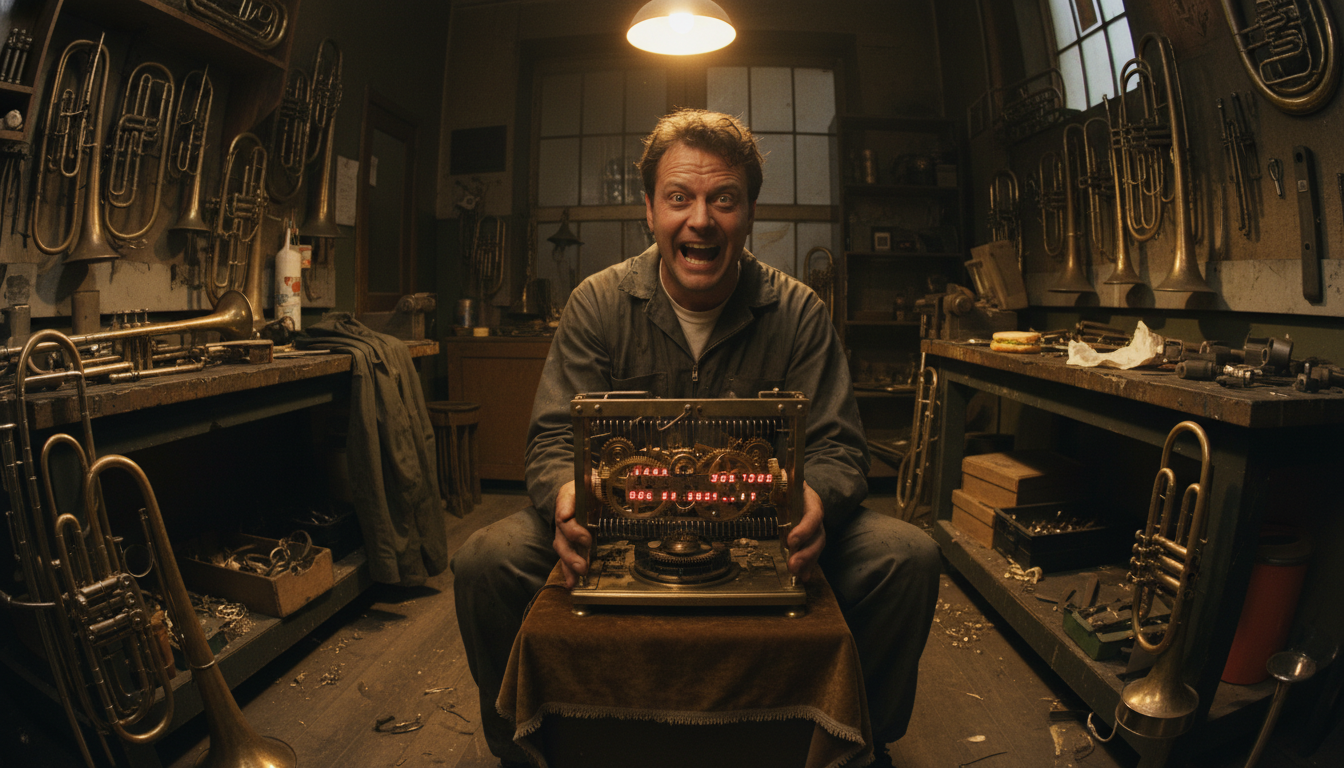
Gus lived his life like he was bracing for an earthquake that was twenty years late. To most people, being blind is a tragedy. To Gus, it was a tactical advantage. He knew his workshop better than a soldier knows his rifle. He could find a tiny brass screw in a drawer full of junk just by the way the air felt when he moved his hand. He treated his home like a bunker. Every rug was a floor marker. Every ticking clock was a sonar ping. He was the king of a quiet, clicking castle.
People are messy. People are loud. They bring dirt into your clean space and they lie without even trying. Gus didn’t like people, but he liked their clocks. Clocks don’t lie. They tell you exactly how tired they are. They tell you if they’ve been dropped or if someone tried to fix them with a butter knife. Gus made his living fixing the heartbeat of the world, one gear at a time.
A man named Seth came in on a Tuesday. Gus knew it was a man because of the heavy, dragging footsteps. Seth smelled like stale cigarettes and cheap car air fresheners. He sounded like a guy who forgot to breathe through his nose. He was a walking liability.
“Fix this,” Seth said. He slammed something heavy onto the velvet pad on the counter. “It stopped. I need it back by Friday. Don’t ask questions.”
Gus didn’t need to ask questions. He could hear the guy’s heart racing. It was a sloppy, frantic rhythm. It didn’t match the heavy thud of the brass object on the table. Gus touched the item. It was a pocket watch, but it was too big. It was a custom job. The casing was thick. It felt like a hunk of lead wrapped in gold.
“Twenty dollars for the intake,” Gus said. “Pickup is Friday. If I can’t fix it, you still pay for the time.”
Seth grunted, tossed a crumpled bill at Gus, and vanished. Gus heard the door click shut. He heard the man’s truck engine turn over. It sounded like a blender full of rocks. A man who drives a truck like that doesn’t care about maintenance. A man who doesn’t care about maintenance is a dangerous variable.
Gus took the brass device to his workbench. He didn’t turn on the lights. He never did. He sat in the perfect, cool darkness and let his fingers do the seeing. He opened the back of the watch.
Usually, a clock sounds like a steady march. This one sounded like a panic attack.
*Tick. Tick-tick. Tick.*
It was a code. Gus felt the vibrations against his fingertips. He had spent forty years listening to the language of metal. This wasn’t a broken spring. This was a deliberate, mechanical message. Someone had filed the teeth on the main gear to create a specific pattern.
Gus grabbed a piece of paper and a slate. He started marking it down in Braille.
*Short. Short. Long. Short.*
It took him three hours. He sat there, as still as a statue, while the rest of the world slept. The code was simple. It was the kind of thing a man does when he thinks he’s the only smart person in the room. It was Morse code.
The message inside the watch was a confession.
*I KILLED BLAIR. BODY IS UNDER THE COAL SHED AT THE OLD MILL.*
Gus felt a cold prickle on the back of his neck. Blair was a name he remembered from the radio. A local girl who went missing five years ago. The town had looked for her for months. They never found a thing. And now, the answer was ticking in Gus’s hand like a physical heart.
He realized Seth wasn’t just a client. Seth was a murderer who had probably stolen this watch from someone else. Or maybe he’d made it as a sick joke. Either way, Seth was coming back. And Seth didn’t know that Gus could “see” exactly what he was.
Gus stood up. He didn’t call the police yet. He knew the police in this town. They were slow. They’d show up with sirens and lights and give Seth plenty of time to run. Gus liked efficiency. He liked things to be resolved with the least amount of wasted energy.
He went to his kitchen and ate a cold sandwich. He chewed slowly. He thought about the perimeter of his shop. He thought about the three steps from the door to the counter. He thought about the heavy cast iron bell he had rigged above the entrance for deliveries.
Friday came fast. Gus spent the time preparing. He didn’t buy a gun. Guns are loud and they can be taken away from you. He preferred gravity and surprise.
At four o’clock, the blender-truck pulled into the gravel lot. Seth was early. He was impatient. That was his first mistake.
Seth burst through the door. “Is it done?”
Gus sat behind the counter. He was holding the brass watch. He looked calm. He looked like a man who didn’t have a care in the world.
“It was a very complex fix,” Gus said. His voice was low and steady. “The gears were filed down. Someone wanted this watch to tell a story.”
The room went silent. Gus could hear Seth’s breath hitch. He could hear the fabric of Seth’s jacket rustling. The man was reaching for something in his pocket.
“What kind of story?” Seth asked. His voice was a jagged edge.
“A story about a girl named Blair,” Gus said. “And a coal shed. It’s a very sad story, Seth. It’s the kind of story that ends with a loud noise.”
Seth moved. He was fast, but he was clumsy. He lunged across the counter.
Gus wasn’t there.
Gus had slipped off his stool the moment he heard the man’s weight shift. He was already two feet to the left, standing in the shadows where he was invisible.
“You think you’re smart?” Seth screamed. He was swinging a heavy wrench. He hit the counter with a metallic *thwack*. “You’re a blind old man! I’ll break your head open!”
Gus didn’t say a word. He moved through the shop like a ghost. He knew where every chair was. He knew where the floorboards creaked. He reached out and pulled a thin nylon cord near the shelf of grandfather clocks.
A dozen heavy weights dropped at once. The sound was like a cannon going off.
*BONG. CLANG. CRASH.*
Seth shrieked. The sudden wall of noise in the tiny, dark room was a physical blow. He staggered back, covering his ears. In the dark, he had no idea where the walls were. He was a leaf in a storm.
Gus moved behind him. He didn’t use a weapon. He just stuck out his foot.
Seth tripped. He fell hard, his chin hitting the corner of a heavy oak table. He let out a muffled “Oof” and hit the floor like a sack of wet flour.
Gus didn’t stop. He stepped over the groaning man and went to the front door. He locked it. Then he went to his phone. He dialed the sheriff’s direct line.
“This is Gus,” he said. “I have a package for you. Bring a shovel. You’re going to need it for the old mill.”
While he waited for the police, Gus went back to his stool. Seth was starting to wake up. He was moaning and clutching his jaw. He tried to crawl toward the door, but he bumped into a display of cuckoo clocks. They all started chirping at once.
“I wouldn’t move, Seth,” Gus said. He was holding the brass watch again. “You’re not good at navigating the dark. You keep hitting things. It’s embarrassing, really.”
Gus felt a strange bubble of warmth in his chest. It was a feeling he hadn’t had in a long time. It wasn’t just the safety of his bunker. It was the joy of a job well done. He had taken a broken situation and he had regulated it. He had brought the world back into a perfect, ticking order.
When the Sheriff arrived, he found Seth tied up with clock-winding twine. The man was curled in a ball, surrounded by a hundred ticking clocks, looking like he’d been tortured by time itself.
The Sheriff looked at Gus. The old man was calmly polishing the brass watch with a soft cloth.
“You okay, Gus?” the Sheriff asked. “He didn’t hurt you?”
Gus smiled. It was a small, sharp smile. “He never even touched me. He’s a very loud man, Sheriff. You can always hear a loud man coming.”
After the police took Seth away, and after they found what was under the coal shed, the town tried to make Gus a hero. They wanted to give him a plaque. They wanted to put his face in the newspaper.
Gus said no to all of it. He didn’t want people in his shop. He didn’t want the noise.
He sat in his workshop that night. The brass watch was gone, taken as evidence. But the silence that replaced it was different now. It wasn’t the silence of a lonely man hiding from the world. It was the silence of a man who knew he was the most dangerous thing in the room.
He picked up a small silver music box that had been sitting on his “to-do” list for months. He opened it. The tiny metal teeth began to pluck at the comb. It played a sweet, simple tune.
Gus tapped his finger on the workbench in time with the music. He was safe. He was smart. And for the first time in twenty years, he didn’t feel like he was waiting for an earthquake. He felt like he was the one who controlled the ground.
He took a bite of a fresh apple. It was crisp. It sounded like a victory.
Gus leaned back in his chair and laughed. It was a dry, rusty sound, but it was real. He was a blind man in a dark room, and he had never seen the world more clearly in his life. Everything was finally on schedule.