
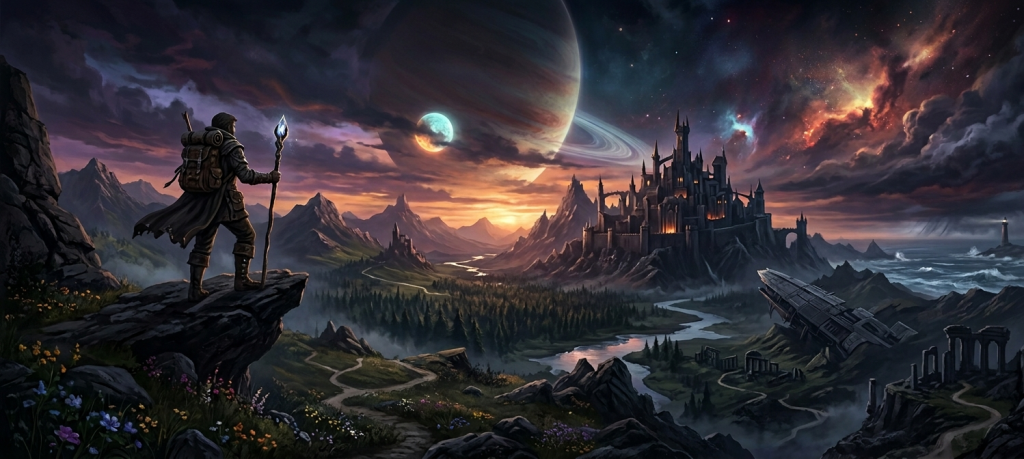
Hattie was a woman who lived in the margins. Her fingers were always stained black, the ink settled deep into the cracks of her skin like a permanent bruise. She didn’t mind. The ink was the only thing keeping the debt collectors from her door. Her father had left her a house with a rotting roof and a pile of bills that reached the ceiling. To save the house, Hattie had to map the Gray Reach. It was a patch of land where the trees grew crooked and the air tasted like wet iron. Nobody ever came back from the Reach, but the Crown wanted to know what was inside.
They gave her a guide. His name was Hayes.
Hayes used to be a Duke. He used to wear silk and drink wine that cost more than Hattie’s house. Now, he wore a coat with frayed sleeves and carried a heavy silence. He had been kicked out of the palace for reasons the city only whispered about. He didn’t look like a man who wanted to find anything. He looked like a man who was waiting for the world to stop turning.
They started their walk in the rain. Hattie carried her parchment and her pens. Hayes carried the heavy packs.
“We won’t find gold in there,” Hayes said on the third night. He was sitting by a fire that hissed and spat. “The King thinks there is a silver mine. There isn’t. There is only cold and mud.”
Hattie looked at her hands. They were shaking. She needed that silver to be real. She needed the map to be perfect so she could stop being afraid of the mail. “I don’t need gold,” she said. “I just need to finish the job.”
Hayes looked at her then. It was the first time he really saw her. He saw the way she tucked her hair behind her ear with an inked finger. He saw the quiet panic in her eyes. He reached into his pocket and pulled out a small, dry piece of bread. He handed it to her.
“Eat,” he said. “The cold eats you if you don’t eat first.”
As they moved deeper into the Reach, the trees began to crowd them. The maps Hattie drew grew more complex. She drew the sharp bends of the river. She drew the cliffs that looked like teeth. But she also began to see things that didn’t make sense. They found a village that had been burned to the ground. The ashes were old, but the stone walls were built with royal crests.
“The Crown said this land was empty,” Hattie whispered. She touched a charred door frame. “There were people here.”
Hayes stood behind her. His hand rested on the hilt of a sword he didn’t use anymore. “The King doesn’t like witnesses,” he said. His voice was a low rasp. “The Reach isn’t a secret because it’s dangerous, Hattie. It’s a secret because it’s a graveyard. We were never supposed to come back.”
The realization hit Hattie like a physical blow. Her stomach turned. The map in her satchel wasn’t a ticket to a better life. It was a death warrant.
“Why did you come?” she asked. “If you knew?”
Hayes looked up at the gray sky. “I had nothing left to lose. Until I met a girl who treats a piece of paper like it’s a holy relic.”
The winter came early in the Reach. It didn’t fall; it attacked. One morning, the world was white and the air was a blade. They were trapped in a small cave on the edge of a high ridge. Hattie was shivering so hard her teeth clicked together. Her ink had frozen in the bottle.
Hayes sat beside her. He took her hands and tucked them under his own coat, against his chest. She could feel his heart. It was slow and steady.
“I’m sorry,” she whispered. “I brought you here for a house I don’t even like.”
“I’m not sorry,” Hayes said. He leaned his forehead against hers. “I haven’t felt the sun in years. I felt it when you looked at the stars last night.”
They stayed like that for a long time. The wind howled outside, a hungry ghost. Hayes knew the math of the cold. He knew they only had enough body heat for one person to survive the night if they shared a single blanket.
He waited until Hattie fell into a shallow, shaking sleep.
He took off his heavy coat and wrapped it around her. He took the map she had worked so hard on and tucked it into the inner pocket, close to her skin. He kissed the ink stains on her knuckles. They tasted like salt and iron.
When the sun came up, the world was blindingly bright. Hattie woke up because she was warm. She was wrapped in layers of wool. She reached out for Hayes, but she only felt the cold stone of the cave floor.
He was sitting near the entrance. He looked like a statue. The frost had settled in his hair and on his eyelashes. He wasn’t moving. His eyes were closed, and his face looked more peaceful than she had ever seen it. He had given her everything he had left: his warmth and his life.
Hattie didn’t scream. She didn’t have the breath for it. She just crawled to him and put her head on his frozen shoulder. She cried until the tears froze on her cheeks.
She made it back. She walked for three days, fueled by a grief that felt like a fire in her bones. She gave the map to the King’s men. She took the gold they gave her. She paid the debts. She fixed the roof of the house.
But Hattie never drew another map of a real place.
The historians who study her work today notice something strange. In the corners of her later drawings, where other artists put sea monsters or dragons, Hattie always drew a man. He is always sitting by a fire, or looking at the stars, or holding a piece of bread. He is the only part of her world she never wanted to forget, and the only part she could never map.
She died with ink on her hands. She died in a house that was warm and dry, but she died alone, still reaching for a hand that had gone cold in a cave a long time ago. The map she left behind didn’t show a silver mine. It showed a path to a place that no longer exists, drawn by a woman who spent the rest of her life trying to find her way back to a ghost.