
I’ve spent twenty years writing about people who lie for a living. Politicians, used car guys, and preachers who sell bottled water that smells like sulfur. I know what a fake looks like. So, when I met Hank in a bar that smelled like wet dogs and desperation, I figured he was just another loser with a map and a dream.
Hank was a cartographer. Or he used to be. He was the guy who drew the lines on the world, but the world stopped following the lines. Five years ago, he mapped a trade route through the valley. Three days later, the valley turned into a mountain, and forty people died because they followed his ink. They called him a murderer. They took his pens and kicked him out of the guild.
Now, Hank sat across from me with a shaking hand and a bottle of cheap rye. He looked like a man who hadn’t slept since the sky started turning that ugly, bruised purple color. The air in our city was getting thin. It tasted like old pennies. People were coughing up gray dust, and the doctors didn’t have a name for it. We were all just waiting for the lights to go out.
“It’s not a map of where things are,” Hank whispered. His voice sounded like sandpaper on a brick. “It’s a map of where they’re going to be. The Tundra isn’t ice, Marcus. It’s a machine. And it’s broken.”
Beside him sat Sloane. She didn’t say a word. She couldn’t. Her throat was a mess of scar tissue from some old accident. She was a scavenger, a girl who lived in the trash heaps and found things that shouldn’t exist. She had a piece of glass in her hand that glowed with a pale, cold light. It wasn’t a battery. It wasn’t a bulb. It just hummed against the wood of the table.
Hank wanted me to document their trip to the Whispering Tundra. He wanted someone to write it down so that if they died, the truth wouldn’t die with them. I didn’t believe him, of course. But I had nothing better to do than watch the world choke to death in my apartment. I grabbed my recorder and my boots.
The Whispering Tundra isn’t like the woods you see in books. There are no trees. There is just a flat, white waste that goes on forever. But it’s not flat. That’s the lie.
We had been walking for three days when the ground decided to move. It didn’t shake like an earthquake. It flowed. One minute, we were standing on a solid sheet of ice. The next, the ice was curling like a wave. It felt like standing on the back of a giant snake. I fell hard, my knees hitting the frozen ground with a crack that made my vision go white.
Sloane was on me in a second. She grabbed my collar and hauled me up. She didn’t look scared. She looked bored. She pointed toward the horizon.
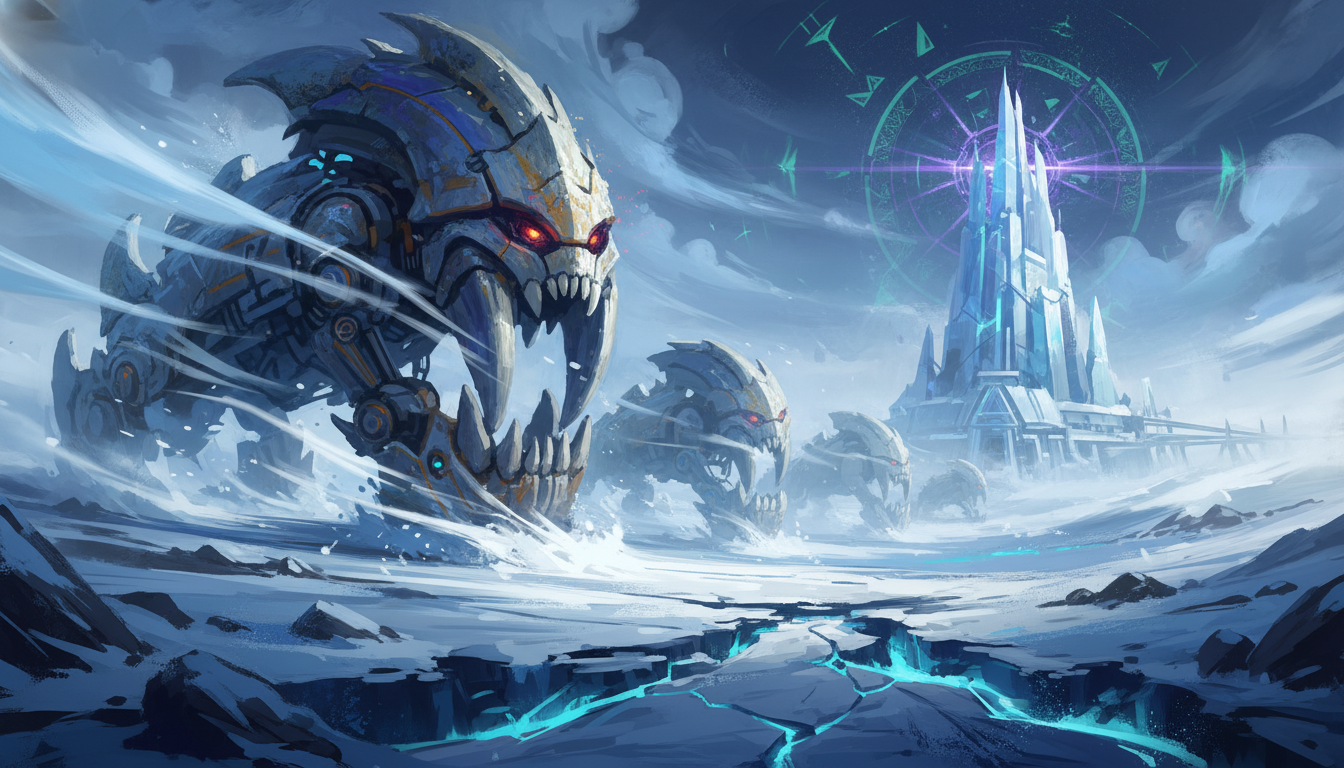
The ground wasn’t just moving. It was rearranging itself. Huge blocks of ice, the size of apartment buildings, were sliding past each other. They made a sound like a million glass plates breaking at once. It was a high, thin screech that made my teeth ache.
“The observatory is at the center,” Hank shouted over the noise. He was staring at a compass that didn’t have a needle. It had a floating drop of liquid that changed color from blue to red. “The land is trying to keep us out. It knows we’re here to reset the clock.”
“It’s just ice, Hank!” I yelled back. My lungs were burning. Every breath felt like I was inhaling tiny needles. “Ice doesn’t think!”
He looked at me with those tired, bloodshot eyes. “This isn’t our ice, Marcus. It’s the skin of something else.”
We kept moving. It was a nightmare. We had to jump over cracks that opened up out of nowhere. We had to climb walls of slush that froze solid in seconds. Sloane was the best of us. She could sense the movement before it happened. She would tap me on the shoulder and point, and five seconds later, the spot where I had been standing would fold into the earth.
By the fifth day, my cynicism was gone. You can’t be a jerk when the world is literally trying to eat you. We were exhausted. Hank’s hands were black with frostbite at the tips. Sloane had a gash on her forehead that wouldn’t stop bleeding. We looked like a joke: a disgraced map-maker, a mute girl, and a reporter who couldn’t even run a mile without wheezing.
Then we saw it.
The observatory didn’t look like a building. It looked like a giant ribcage made of silver. It sat on top of a peak that shouldn’t have been there. The mountain was growing out of the ground like a tooth. It was miles high, poking through the thick, purple clouds.
“We have to climb that?” I asked. My voice was a wheeze.
Hank nodded. He looked at the mountain with a mix of fear and love. “The stars are coming, Marcus. The ones from the other side. If we aren’t at the top to open the lens, the air will turn to poison for good. We won’t wake up tomorrow.”
The climb was a blur of pain. My fingers felt like they were being snapped off one by one. The air got thinner and thinner until I was gasping like a fish on a boat deck. Sloane was ahead, her small body moving with a grace that didn’t make sense. Hank was behind me, his breath coming in wet, ragged pops.
We reached the top just as the sun went down. But it didn’t get dark.
The sky began to tear. That’s the only way I can describe it. The purple clouds didn’t drift away. They split open like a piece of fruit. Behind them, the sky wasn’t black. It was a deep, impossible gold.
And then the stars appeared.
They weren’t points of light. They were huge, glowing spheres that looked close enough to touch. They weren’t round. Some were shaped like diamonds, others like long, glowing needles. They moved in patterns that made my brain hurt. They hummed. The sound was so deep it vibrated in my chest, shaking my very heart.
Hank scrambled to the center of the silver ribcage. There was a glass bowl filled with the same liquid from his compass. He plunged his frostbitten hands into it.
“Help me!” he screamed.
Sloane and I ran to him. We grabbed his shoulders as he pulled a lever that looked like it was made of bone. The silver ribs began to spin. They whirled around us, faster and faster, until they were just a blur of chrome.
The stars responded. A beam of golden light shot down from the largest sphere. It hit the bowl in front of Hank. The light was so bright I had to close my eyes, but I could still see it through my eyelids. It was warm. It didn’t burn. It felt like a summer afternoon on your skin after a long, cold winter.
I felt a sudden, sharp pop in my ears.
The smell of old pennies vanished. In its place came the scent of rain, crushed grass, and something sweet like honey. My lungs expanded. For the first time in years, the air didn’t hurt. It felt clean. It felt new.
I opened my eyes.
The golden sky was fading, turning back into a deep, healthy blue. The giant stars were receding, pulling back into the distance until they were just tiny sparks. The mountain beneath us began to sink. It was a gentle ride, like an elevator.
Hank was slumped over the bowl. He was crying. Not the kind of crying you do when you’re sad, but the kind you do when you’ve been carrying a weight for a lifetime and someone finally takes it from you. Sloane was standing at the edge of the ribs, her face tilted up to the sky. She looked like she was hearing a song only she knew the words to.
I looked down at my hands. They were shaking. I’m a guy who deals in facts. I deal in the dirty, the mean, and the small. But standing there, on a mountain that was melting back into the earth, I felt something I hadn’t felt since I was a kid.
I felt small. Not small like a bug, but small like a grain of sand on a beach that goes on forever. It was the most wonderful feeling in the world.
We made it back to the city three weeks later. The gray dust was gone. People were out in the streets, looking up at the blue sky like they were seeing it for the first time.
Hank didn’t go back to the guild. He didn’t want his pens back. He bought a small house near the edge of the Tundra and started a garden. Sloane stayed with him. They don’t talk much, but they don’t have to.
As for me, I still have my recorder. I have the tapes of the ice screaming and Hank’s ragged breath. I haven’t written the story yet. I’m not sure I can. How do you put ink on paper to describe the moment the universe looked at you and decided to let you keep breathing?
Every night, I go out to my balcony. I look up at the stars. They look normal now. Just little white dots in the dark. But I know better. I know what’s behind the curtain. I know that somewhere out there, the big needles and the diamond suns are still humming.
The world is a joke, sure. It’s messy and it’s mean and it’s mostly a disaster. But every once in a while, the punchline is beautiful. And that’s enough to keep me from closing my eyes.