

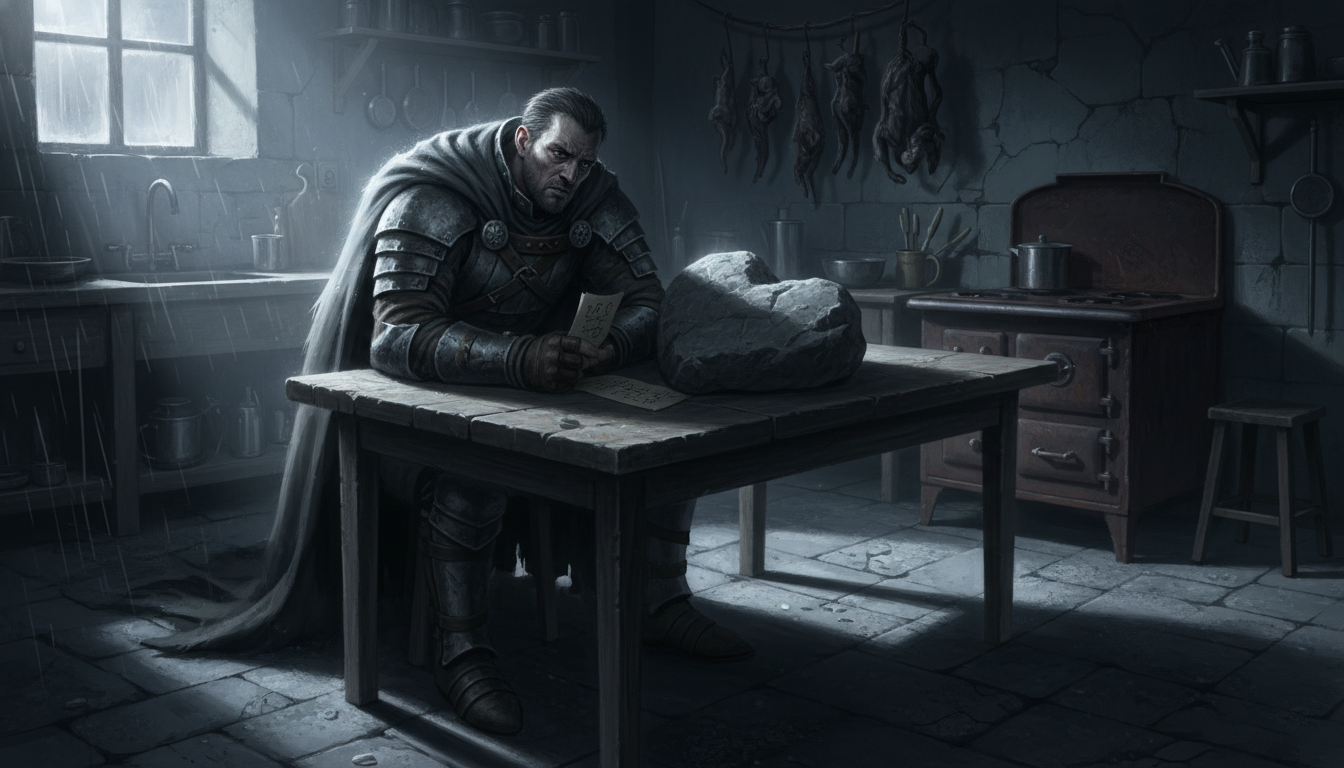
Sit down and shut up. If you want a drink, you listen to the story. This isn’t some fairy tale with a happy ending and a magic bird. This is about Gus. Gus was a guy who worked for the wrong people because he had a face like a smashed potato and the social skills of a brick. He was a henchman: a guy who stood in the back of the room and looked mean while the boss, a jerk named Victor, ranted about world ending spells.
Gus had a deep wound in his soul that most people didn’t see. He didn’t want to conquer the world. He didn’t want to burn down the capital. Gus just wanted to smell yeast. He wanted to feel the sticky push and pull of rye dough under his palms. His vital need was a kitchen with a warm hearth and a window that looked out on a field of grain. Instead, he got a damp cave and a spiked club.
The day everything went sideways started with a scream and a k-clack. The great hero, a golden boy named Marcus, broke into the throne room. He was shining like a new penny. Victor was standing there, laughing that high: thin laugh that makes your teeth ache. They started throwing magic and steel at each other. Gus stood in the corner, trying to look invisible. He was thinking about how much he missed his grandmother’s kitchen. He could almost smell the cinnamon. He could almost see the way the flour dust danced in the afternoon sun back in the village.
Then it happened. Marcus threw a bolt of light. Victor threw a ball of shadow. Both hits missed the target and slammed into the giant glass chandelier. It was a massive: ugly thing made of black crystals. The chain snapped.
The sound was like a mountain cracking in half. The chandelier fell. It didn’t just hit one of them: it flattened both of them. One second, you had a war for the soul of the world. The next second, you had two pairs of boots sticking out from under three tons of jagged glass. The room went dead silent.
Gus looked at the other henchmen. He looked at the dead hero. He looked at the dead boss. He felt a coldness in his chest that had nothing to do with the draft in the cave. He realized he was the only one left standing near the throne. The guards outside were already shouting. They wanted to know who won. If they found out the boss was dead, they would burn the place down and kill everyone inside.
Gus did the only thing a panicked man could do. He grabbed Victor’s jagged crown from the floor. He jammed it on his head. It was too big and the sharp edges cut into his ears. He felt his neck bones pop like dry sticks under the weight of it. He threw on the velvet cape, which smelled like old goat and wet dogs.
The heavy doors kicked open. A captain of the guard named Vera ran in. She saw the mess. She saw the bodies. Then she saw Gus.
Gus felt himself expanding like a panicked pufferfish. He used his “scary voice,” the one he used to scare crows away from his garden back home.
“The hero is dead,” Gus bellowed. His voice shook, but in the big room, it sounded like thunder. “And Victor was weak. I am the King now. Get me some wine and leave me alone.”
Vera stared at him. Her eyes were wide. She looked at the blood on the floor and the crown on Gus’s lumpy head. She bowed. She actually bowed.
That was three years ago. Now, Gus sits on a throne made of swords that poke him in the butt every time he moves. He has to pretend to be a monster. If he shows a drop of kindness, the generals will kill him. If he tries to leave, the peasants will mob him. He is a prisoner in a fancy suit.
Every morning, Gus wakes up and feels a deep: soulful ache. He looks at his hands. They are covered in rings and gold, but they should be covered in flour. He spends his days signing death warrants for spies and listening to Vince, his tax collector, talk about grain taxes.
Vince is a skinny guy who smells like old paper. One day, Vince brought in a sample of the harvest. He put a small sack of wheat on the table. Gus reached out and touched it. The texture of the grain made his eyes sting. He remembered his mother’s hands. He remembered the way the air felt right before a summer rain. He felt like a ghost haunting his own life.
“Is the grain good?” Gus asked. His voice was a raspy growl. He had to keep up the act.
“It is okay, your majesty,” Vince said. “But the bakers say it lacks a certain something.”
Gus wanted to scream. He knew exactly what it lacked. It lacked a slow rise. It lacked a touch of salt and a hot oven. He wanted to go down to the kitchens and show them. He wanted to take off the heavy: stupid crown and put on an apron.
Instead, he threw the sack of wheat across the room. “Tell them to bake better bread or I will have their heads,” Gus yelled.
He watched the sack burst against the wall. The white powder sprayed into the air. For a second, just a tiny second, the room smelled like home. Gus sat back and closed his eyes. He let the nostalgia wash over him like a warm tide. He remembered the simple “click” of a wooden spoon against a bowl. He remembered the way a fresh loaf sounded when you cracked the crust. It was a song.
The weight of the crown felt like a thousand pounds. He looked out the window at the dark mountains. He was the most powerful man in the kingdom, and he was starving. Not for meat or wine, but for a life that was gone. He was a baker dressed as a butcher.
Gus stood up. His cape snagged on a spike. He heard the fabric rip. He didn’t care. He walked to the window and looked down at the village far below. He could see the smoke from the small chimneys. Somewhere down there, someone was pulling a tray out of an oven. Someone was laughing. Someone was free.
He gripped the stone window sill until his knuckles turned white. He had to stay. He had to keep the peace. If he quit, the war would start again. The bodies would pile up. He stayed a tyrant so the world could stay quiet. It was a heavy price to pay for a man who just wanted to make cookies.
So he turned back to the room. He looked at the guards waiting for his next order. He folded his arms, feeling his heart beat against his ribs like a trapped bird.
“Vera,” Gus barked.
“Yes, my King?” the captain asked.
“Bring me a rolling pin,” Gus said. He saw her confused look. “I want to… use it for torture. Get the heavy one. The one made of oak.”
She hurried away. Gus sat back down. He could almost feel the wood in his hand. It wasn’t the life he wanted, but it was the only piece of it he could keep. He closed his eyes and breathed in the dust: pretending it was flour: pretending he was home.