

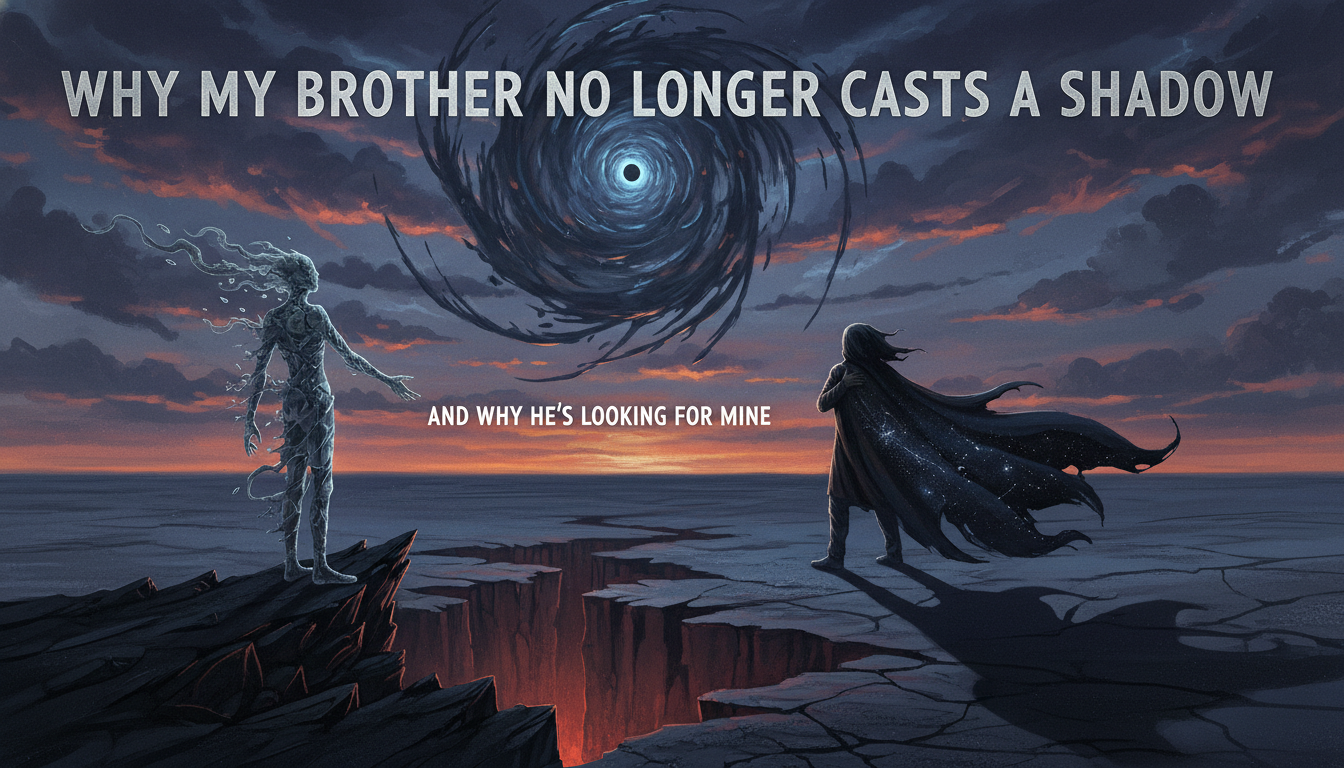
Leo ate his steak medium-rare, the red juice pooling on the white ceramic plate like a fresh crime scene. A month ago, he couldn’t keep down a saltine. A month ago, the Stage IV adenocarcinoma was a greedy tenant, eating him from the inside out until his ribs looked like a birdcage. Now, he was thick-necked and vibrant. But when the overhead diner light hit him, the floor beneath his boots stayed bright. The linoleum was a flat, unbroken yellow.
Elias watched his brother’s throat work as he swallowed. Elias was a man who lived in the margins of police reports and the stench of city hall basements, but this—this silence where a shadow should be—was a story that made his bile rise. He had spent his life failing Leo. He’d missed the graduation, the wedding, the first signs of the jaundice. He’d promised their dying mother he’d look out for the kid, and instead, he’d chased leads into the bottom of a whiskey bottle. This “cure” was Elias’s last chance to be a brother, even if it felt like he was hugging a corpse that hadn’t realized it was dead yet.
“You’re staring again, El,” Leo said. His voice was different. It didn’t have that brotherly warmth anymore; it sounded like two stones grinding together in deep water.
“Just glad to see you eating,” Elias lied. His notebook sat heavy in his jacket pocket, filled with the name *Aris Thorne* and the address of a warehouse in the Meatpacking District that didn’t exist on any municipal map.
“Thorne said there would be side effects,” Leo muttered, wiping blood from his lip. “A little light sensitivity. A little… disconnect. Small price for not being a pile of ash in a jar, right?”
Elias looked down. Under the table, Leo’s feet were firmly planted. But there was no dark shape stretching toward Elias’s own loafers. Just a void. A vacuum in the light.
The procedure was called “The Graft.” Thorne, a surgeon who’d been stripped of his license after three patients ended up with their internal organs rearranged like a cubist painting, had found a way to cheat the reaper. He didn’t use chemicals or radiation. He used the “Umbra.” He’d figured out that the human shadow wasn’t just an optical fluke—it was an anchor. A tether of soul-matter that held the body to the physical plane. By grafting a “living shadow”—harvested from God-knows-where—onto a failing organ, Thorne could jumpstart the meat.
But a body can only hold one shadow. The original one gets kicked out. It becomes a stray.
Elias walked Leo to his car. The parking lot was flooded by a high-pressure sodium lamp. Elias’s shadow was long and gangly, a distorted mirror of his own cynical posture. Beside it, Leo was a ghost in broad daylight.
“I’ll call you tomorrow,” Leo said. He didn’t look Elias in the eye. He looked past him, at the dark mouth of an alleyway across the street.
“Leo, wait. Have you seen anything? Around the house? In the corners?”
Leo’s hand froze on the car door. The skin on his knuckles was translucent, like parchment. “It’s just a shape, El. It’s just… an echo. Thorne said it would go away once it realized it didn’t have a home anymore.”
He got in and drove away. Elias stayed under the orange light. He felt a sudden, sharp prickle at the base of his neck. He turned.
There, near the dumpster, a patch of darkness was moving. It wasn’t a shadow cast by a cat or a trash can. It was a flat, two-dimensional silhouette of a man. It moved with a jerky, stop-motion gait, peeling itself off the brick wall and sliding across the asphalt. It didn’t have a face, but Elias felt its gaze. It was the shape of his brother—the slumped shoulders, the slightly crooked gait—but it was hungry. It was a hole in the world, and it was looking for a way back in.
Elias didn’t go home. He drove to the warehouse.
The air inside the Meatpacking District facility smelled like copper and wet dog. No machines hummed. There were only candles—hundreds of them—flickering in jars, casting a chaotic web of shadows that danced and overlapped.
Dr. Aris Thorne sat behind a desk made of reclaimed shipwreck wood. He was a man who looked like he’d been ironed flat. His skin was too tight, his eyes too bright.
“The journalist,” Thorne said, his voice a dry rasp. “Come to write a profile on the man who conquered the grave?”
“I’ve seen what Leo’s shadow is doing, Thorne,” Elias said, his hand trembling as he reached for his recorder. “It followed me. It looks like it’s starving.”
Thorne leaned forward. The candlelight hit him, but his shadow on the back wall was wrong. It was too big. It had too many limbs. It was twitching independently of Thorne’s movements, its fingers elongated like spiders.
“Of course it’s starving,” Thorne whispered. “It’s been severed from its source of heat. It’s a parasite without a host. It wants its meat back, Elias. But it can’t have Leo’s. The new graft won’t let it in. It’s like an organ transplant rejection, but on a spiritual level.”
“So what does it do?”
“It looks for the next best thing,” Thorne said. He smiled, and his shadow’s mouth opened three times wider than his own. “It looks for the people who share the same blood. The same resonance. It looks for family.”
The coldness hit Elias then. A physical weight on his chest, like a slab of ice. He thought of his small apartment. He thought of the way the light in his hallway flickered.
“Why?” Elias choked out. “Why do this?”
“Because death is a lack of imagination,” Thorne said. “I’m just providing a new neighborhood for the soul.”
Elias backed away. He stumbled over a candle jar, shattering it. The shadows in the room surged toward the new darkness. He ran.
He drove to Leo’s house, his heart hammering against his ribs like a trapped bird. He had to get Leo out. He had to find a way to fix this. He pushed through the front door, calling his brother’s name.
The house was silent. The lights were all on—every lamp, every overhead, every nightlight. It was a frantic, blinding fortress of electricity.
“Leo?”
He found him in the kitchen. Leo was sitting on the floor, surrounded by a ring of high-powered work lights he must have bought at a hardware store. He was shivering.
“It’s in the walls, El,” Leo whispered. His eyes were bloodshot, rimmed with a terrifying white circle of panic. “I can hear it sliding. It sounds like sandpaper on silk.”
“We’re leaving,” Elias said, reaching for his brother’s arm.
“Don’t!” Leo screamed. “If you step into the light, you’ll cast one. You’ll give it a bridge!”
Elias looked at his own shadow, stretched out long and dark across the kitchen tiles. It touched the edge of the darkness beneath the refrigerator.
Suddenly, the kitchen light flickered. A bulb popped.
In the sudden dimness, a shape rose from the floor. It didn’t have mass, but it had presence. It was a blacker-than-black silhouette of Leo. It didn’t walk; it flowed. It slid up the cabinet, onto the ceiling, and then dropped.
It didn’t go for Leo. It ignored the man it used to belong to.
It landed on Elias’s shadow.
Elias felt a scream die in his throat. It wasn’t a physical blow. It was worse. It was a sudden, agonizing drain. It felt like his blood was being replaced with slush. He watched, paralyzed, as the predatory shadow began to merge with his own. His own silhouette began to warp, its head elongating, its fingers sharpening into the shape of his brother’s ghost.
“El!” Leo cried, but he stayed within his ring of light. He stayed safe. He stayed alive.
Elias felt his vision blurring. His skin felt cold—not the cold of a winter wind, but the cold of a cellar that hasn’t seen the sun in a century. He looked down at his hands. They were turning gray. The color was leaking out of him, flowing down his arms, into the floor, feeding the thing that wanted to be real again.
He saw the story now. The one he’d spend the rest of his life writing, though he’d never find a paper to print it. It was the story of a man who’d spend his life in the dark, watching his brother live in the sun.
The last light in the kitchen exploded.
In the total darkness, Elias felt something cold and flat wrap around his heart. It felt like his brother’s hand, but there was no skin. There was only the hunger of a thing that had been forgotten.
He didn’t scream when the teeth—which weren’t teeth at all, just a sharper kind of silence—tore into his soul. He just felt a deep, soul-aching regret that he’d finally found a way to be there for his brother.
The next morning, Leo walked out into the sun. He felt wonderful. He felt vibrant. He felt like a man with a long life ahead of him.
He didn’t look back at the house. He didn’t look at the shadow stretching out behind him—a long, gangly shadow with the cynical posture of a journalist, twitching in the morning light, waiting for the sun to go down so it could find the rest of the family.